Define the multiplier and rate of inflation, Macroeconomics

Assignment Help:

1 (a) List two concerns with inflation.

(b) Suppose that we are in a condition of fully flexible prices, but production of nails will not go above 200 chairs/month. What price will chairs sell for if market demand is characterized by: (a) P=425-1.5Q, (b) P=530-1.5Q, and (c) P=400-0.5Q, where P is in $/chair and Q is in chairs/month?

(c) What are two reasons why prices might be sticky?

Ans: First, consumers prefer stable and predictable prices. Companies recognize this.

2 (a) Net investment can be positive, negative, or zero, but gross investment can never be less than zero. Explain.

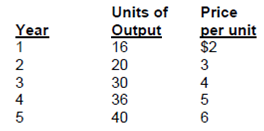
(b) Consider the following price and output data over a five-year period for an economy that produces only one good. Assume that year 2 is the base year.
2418_unit of output.png

i. If year 2 is the base year, give the price index for year 3.

ii. Give the nominal GDP for year 4.

iii. What is the real GDP for year 4?

iv. Tell which years you would deflate nominal GDP and which years you would inflate nominal GDP in finding real GDP.

3. (a) Explain why even small changes in the rate of economic growth are significant. Use the "rule of 70" to demonstrate the point.

(b) Are economic growth and progress synonymous? How might they differ?

(c) What phase of the business cycle is the Canadian and your provincial economy experiencing at the present time? Justify your answer.

4. (a) How is the unemployment rate affected if employment increases from 9 million to 9.5 million and the labour force increases from 10 million to 11 million?

(b) The table below shows the price index in the economy at the end of four different years.

2122_year of double.png

i. What is the rate of inflation in years 2, 3, and 4?

ii. Using the "rule of 70," determine how many years would it take for the prices to double at each of these three inflation rates?

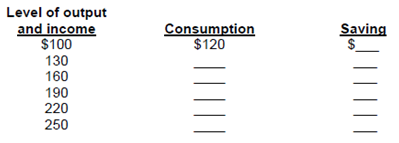
5. (a) Complete the following table assuming that (a) MPS = 1/3, (b) there is no government and all saving is personal saving.
705_consuption.png

(b) Define the multiplier. How is it related to real GDP and the initial change in spending? How can the multiplier have a negative effect?


Related Discussions:- Define the multiplier and rate of inflation

Overnight target rates and inflation, Overnight target rates and inflation ...

Overnight target rates and inflation One of the major targets of every central bank is a low and stable inflation. Its main control variable is the overnight interest rate tar

International trade, developing countries benefit through international tra...

developing countries benefit through international trade from developed countries

Correlation of investment and interest rate, Suppose the demand for loanabl...

Suppose the demand for loanable funds was stable but the supply fluctuated from year to year. what cause fluctuate in supply?

Trade-off proposals, While referring to the "EYE on YOUR LIFE" section on p...

While referring to the "EYE on YOUR LIFE" section on page 235 of the textbook, and the economic concepts you have accumulated during our course, consider the trade policies that se

Newton''s donuts has been estimated, The demand function for Newton's Donut...

The demand function for Newton's Donuts has been estimated as follows: Qx = -14 - 54Px + 45Py + 0.62Ax where Qx represents thousands of donuts; Px is the price per donut; Py

State about the gross domestic product, Gross domestic product Definit...

Gross domestic product Definition Perhaps the most significant concept in macroeconomics is Gross Domestic Product (GDP): Gross Domestic Product (GDP) is defined as the

Calculate the total cost and minimum cost, Consider a hospital that produce...

Consider a hospital that produces output (Q) and has two production inputs, nurse-hours (N) and beds (B). the hospital faces input costs of W N = 15 and W B = 25. Assume the h

What is difference between explicit cost and implicit cost, What are the di...

What are the difference between explicit cost and implicit cost? Both are concerns to Opportunity Cost and Decisions: An explicit cost is a cost which involves essentially

Neo-classical thinking on growth, Neo-classical thinking on growth: Neo...

Neo-classical thinking on growth: Neo-classical  thinking  on  growth  is  owed  to  the Robert  Solow  whose  exogenous  growth models in the of the mid-20th century remained

Equilibrium in the money market, Equilibrium in the money market  ...

Equilibrium in the money market  In the IS-LM-model, we have equilibrium in the money market when MD(Y, R) = MS   This is the equation

Write Your Message!

Captcha
Free Assignment Quote

Assured A++ Grade

Get guaranteed satisfaction & time on delivery in every assignment order you paid with us! We ensure premium quality solution document along with free turntin report!

All rights reserved! Copyrights ©2019-2020 ExpertsMind IT Educational Pvt Ltd