Show the ad curve over time, Macroeconomics

Assignment Help:

Q. Show the AD curve over time?

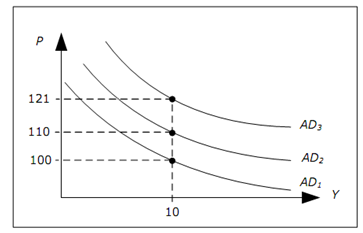
With inflation, AD curve will no longer be stable over time. In its place, it will glide upwards or downwards at a rate determined by growth rate of the money supply ΠM. Let's look at the case ΠM = 10%.

If AD1 is AD curve in year 1, AD1would show us all combinations of Y and P where both markets are in equilibrium in year 1. For instance, both markets are equilibrium at point A where P = 100 and Y = 10. 

Figure: AD curve glides if ΠM 0

588_Show the AD curve over time.png

In year 2, money supply is higher - it has increased by just 10%. If P had increased by 10%, then this new value of P together with the level of GDP we had last year would still give us equilibrium in both markets. Inflation has then been 10% and none of the LM or IS curves have shifted.  

In year 2, P = 110 and Y = 10 should be on AD2. In year 3, by same arguments, P = 110.1.1 = 121 and Y = 10 should be on the AD3 and we see that AD curve glides upwards by 10% per year - exactly the same rate as growth in the money supply.


We should remember that if ΠM ≠ 0, then AD curve is applicable only for a given point in time. At another point in time, we should draw a different AD-curve. The rate at which AD curve glides is equal to ΠM - if ΠM is high, a higher inflation is essential if the same level of GDP is to lead to equilibrium in both markets. 

Even though ΠM determines evolution of the AD curve over time, there are still many combinations of Y and P leading to equilibrium in the goods- and money market (all points on the AD curve at specifically the given point in time). Only one point will be an equilibrium point for the entire economy and as before, AS curve will help us to find this point.


Related Discussions:- Show the ad curve over time

Outline two main restrictions by indian government applied t, outline two m...

outline two main restrictions by indian government applied to import. Using the data from your case study analyse and explain who would benefit directly and who would lose directly

What is quantitative easing, What is Quantitative easing Quantitative ...

What is Quantitative easing Quantitative easing (QE) is an unorthodox monetary policy which since 2009 has been intermittently pursued by Bank of England and US Federal Reserv

Estimated annual expense, The annual income from an apartment complex is $2...

The annual income from an apartment complex is $20,664. The annual expense is estimated to be $3,414. The apartment complex could be sold for $146,499 at the end of 10 years. If yo

Monetization of public debt, What are the pros and cons of monetization of ...

What are the pros and cons of monetization of public debt

Pat, Explain the concept of diminishing returns to labor.

Explain the concept of diminishing returns to labor.

Trading nation is impacted, In a ___________ exchange rate system each trad...

In a ___________ exchange rate system each trading nation is impacted directly by the supply and demand for their currency. A) Fixed B) Dirty C) Floating D) Clean

Importance of macroeconomics models, Importance of macroeconomics models ...

Importance of macroeconomics models Using the models we can, for example, analyze what happens when the government increases consumption, when the central bank increases the tar

Subsidizing the price of milk, "Subsidizing the price of milk or other agri...

"Subsidizing the price of milk or other agricultural products is not very expensive considering how many consumers there are in the United States. Therefore, there is little harmfu

Write Your Message!

Captcha
Free Assignment Quote

Assured A++ Grade

Get guaranteed satisfaction & time on delivery in every assignment order you paid with us! We ensure premium quality solution document along with free turntin report!

All rights reserved! Copyrights ©2019-2020 ExpertsMind IT Educational Pvt Ltd