Charge and electric force, Electrical Engineering

Assignment Help:

Charge and Electric Force

The proton has a charge of +1.602 10-19 coulombs (C), while the electron has a charge of -1.602 × 10⁻¹⁹ C. The neutron has zero charge. Electric charge and, more so, its movement are the most basic items of interest in electrical engineering. When many charged particles are collected together, larger charges and charge distributions occur. There may be point charges (C), line charges (C/m), surface charge distributions (C/m2), and volume charge distributions (C/m3).

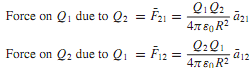
A charge is responsible for an electric ?eld and charges exert forces on each other. Like charges repel, whereas unlike charges attract. Such an electric force can be controlled and utilized for some useful purpose. Coulomb's law gives an expression to evaluate the electric force in newtons (N) exerted on one point charge by the other:
607_Charge and Electric Force.png

1. Forces ¯ F21 and ¯ F12 are experienced by Q1 and Q2, due to the presence of Q2 and Q1, respectively. They are equal in magnitude and opposite of each other in direction.

2. The magnitude of the force is proportional to the product of the charge magnitudes.

3. The magnitude of the force is inversely proportional to the square of the distance between the charges.

4. The magnitude of the force depends on the medium.

5. The direction of the force is along the line joining the charges.


Related Discussions:- Charge and electric force

Determine the total energy loss, Determine the total energy loss: Two ...

Determine the total energy loss: Two capacitors C 1 = 50 μF and C 2 = 100 μF are connected in parallel across 250 V supply. Determine the total energy loss. Figure

Determine the resultant line current and power factor, Q. A three-phase loa...

Q. A three-phase load, connected to a 440-V bus, draws 120 kWat a power factor of 0.85 lagging. In parallel with this load is a three-phase capacitor bank that is rated 50 kVAR . D

Discuss the characteristics of embedded systems, Problem : a) What is a...

Problem : a) What is an "Embedded System"? Discuss the characteristics of Embedded Systems. b) Describe three downfalls of "Embedded Systems". c) Explain the difference b

Mesh analysis procedure, Mesh analysis procedure : 1.  Assign a distinct...

Mesh analysis procedure : 1.  Assign a distinct current to every closed loop of the network. 2.  Apply KVL around every closed loop of the network. 3.  Solve the resulting

Hall effect - semiconductor, Explain hall affect and derive the mathematic...

Explain hall affect and derive the mathematical expression for hall coefficient, also describe its applications. Sol. Hall effect If a metal or semiconductor material carr

Calculate the power dissipated in r and in the diode, Q. Consider the circu...

Q. Consider the circuit of Figure with V S = 94 V, V Z = 12 V, R = 820 , R L = 220 , R S = 0, and R Z = 25 . Assume the reverse saturation current of the zener diode to be

Principals applied in product design, What are the broad principals that wi...

What are the broad principals that will be applied in product design to facilitate automated assembly ?

Strategic perspective of an organization, Strategic Perspective of An organ...

Strategic Perspective of An organization Strategic perspectives cover functions such as revenue, customer satisfaction, people, procedure and technology. Every organization re

What is ammeter, What is ammeter An ammeter is an instrument used to ca...

What is ammeter An ammeter is an instrument used to calculate current and must be connected in series with the circuit.

Write Your Message!

Captcha
Free Assignment Quote

Assured A++ Grade

Get guaranteed satisfaction & time on delivery in every assignment order you paid with us! We ensure premium quality solution document along with free turntin report!

All rights reserved! Copyrights ©2019-2020 ExpertsMind IT Educational Pvt Ltd