Carbonization process, Biology

Assignment Help:

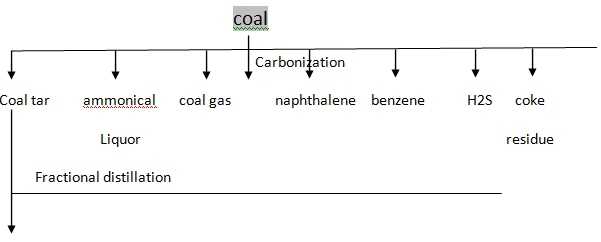
When coal is heated strongly in absence of air, it forms a strong, porous, dense and coherent mass known as coke. This process of conversion of coal into coke is called carbonzation.

(Note: The coal on carbonization becomes soft, plastic and fuse together to a large coherent mass, they are called caking coals. Such coals are difficult to be oxidized. If the coke obtained is porous, hard, strong and usable for metallurgical purposes, then the coal is known as coking coal.)                            

Steps involved in carbonization process
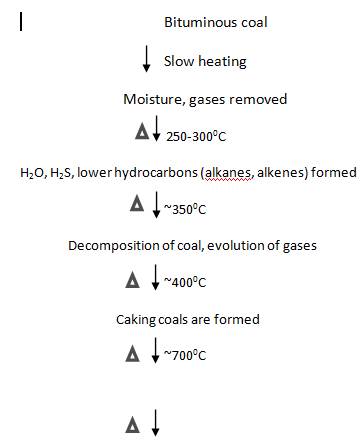
                                                                   904_carbonization.png

                                                                            Hydrogen is eliminated

                                                                                            ~8000C

                                                            Formation of plastic mass, evolution of gases

                                                                                              9000C

                                                                            Coke is formed by

                                                            Solidification of plastron, foam like mass              

There are two types of carbonization.

1.      Low temperature carbonization.

2.      High temperature carbonization.   

1.11.1 Low temperature carbonization

When the carbonization is carried out at 500-7000C, that it is called low temperature carbonzation. The coke contains 5-15% volatile matter and cannot be used for metallurgical processes. It ignites easily and is used in domestic usages. Coke obtained is smokeless and the byproduct gas obtained has high calorific value (6500-9500kcal/m3).

1.11.2 High temperature carbonization

When carbonization is carried out at 900-12000C, it is called high temperature carbonization. The coke produced has high strength, purity, hardness, desired porosity, and is used for metallurgical purposes. Coke obtained has low volatile matter (1 - 3 %) and the byproduct gas obtained has low calorific value (5400-6000 (kcal/m3).
 

1939_carbonization1.png


Related Discussions:- Carbonization process

Explain the bioavailability of vitamin d, Explain the Bioavailability of Vi...

Explain the Bioavailability of Vitamin D? The nutritional availability of vitamin D is less significant because it can be endogenously produced and retained for long periods by

All or None Response, All or None Response A very weak stimulus does n...

All or None Response A very weak stimulus does not result in an action potential. The stimulus must have a certain strength to evoke an excitation. This is the threshold value

Explain some limitations of most probable number, Explain some Limitations ...

Explain some Limitations of Most Probable Number? 1. Large quantity of glassware is required. 2. Colony morphology cannot be determined. 3. It lacks precision.

Explain the functional properties of proteins, Functional properties of pro...

Functional properties of proteins These are those physico-chemical properties that enable the proteins to contribute to the desirable characteristics of the food Potential f

Explain the types of carrageenan, Explain the types of Carrageenan It ...

Explain the types of Carrageenan It was first produced commercially from the red algae, Chandrus crispus, found along the northeast shores of the U.S and Canada and referred t

Clotting disorder - haemophilia, Clotting Disorder - Haemophilia Haemo...

Clotting Disorder - Haemophilia Haemophilia  is a congenital  blood clotting  disorder caused by the genetic lack/ deficiency of  coagulation factor VIII or antihaemophiliac

Chapter-2, multiple choise question

multiple choise question

Can you explain the process of twins generation, Q. What are twins? Genetic...

Q. What are twins? Genetically what are the two types of twins that can be generated? Twins are at the same time generated (within the mother's uterus) offspring. Twins classif

Nervous system and types of reproduction, Q Annelid Identity card. How are ...

Q Annelid Identity card. How are they characterized according to examples of representing beings, type of symmetry, basic morphology, germ layers and coelom, respiratory system, di

Write Your Message!

Captcha
Free Assignment Quote

Assured A++ Grade

Get guaranteed satisfaction & time on delivery in every assignment order you paid with us! We ensure premium quality solution document along with free turntin report!

All rights reserved! Copyrights ©2019-2020 ExpertsMind IT Educational Pvt Ltd