What are the various types of point defects, Chemistry

Assignment Help:

What are the various types of point defects? How are they caused?
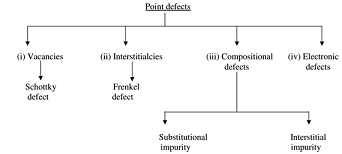
 

2439_point defect.png

(i) Vacancies: This refers to a missing atom or a vacant atomic site because of absence of a matrix atom.

Missing  of  one  cation  and  one  anion  ion  in  an  ionic  crystal  is known as Schottky imperfection. Electrical neutrality is sustained in this type of imperfection which is observed in alkali halides.

(ii) Interstitialcies: An extra atom (substantially smaller than parent atoms) enters interstitial void or space between regularly positioned atoms. Vacancy and interestitialcy are, hence inverse phenomena.

Displacement  of  cation  ions  from  a  lattice  site  into  the  void  space  is  known as Frankel imperfection and this results in creation of vacancy. An imperfection don't affect the overall electrical neutrality of the crystal.

Compositional defect:

(iii) Substitutional impurity: Presence of foreign atom in place of a matric atom is known as substitutional impurity.

If  a  foreign  atom  occupies  a  vacant  position  within  crystal  lattice,  this  defect  is known as interstitial impurity.

(iv)  Electronic  defects:  Errors  in  charge  distribution  in  solids  are  termed  as  electronic defects.  There is departure from the normal regularity of charge distribution. This effect is responsible for the operation of p-n junction and transistors.

Point defects formed by

(i) Thermal fluctuations during preparation of crystals.

(ii) Quenching (quick cooling) from a higher temperature

(iii) Severe deformation such as hammering or rolling.

(iv) External  bombardment  by  atoms  or  high  energy  particles( for example Cyclotron of nuclear reactor).


Related Discussions:- What are the various types of point defects

The following set of quantum numbers is possible, Which of the following se...

Which of the following set of quantum numbers is possible: (1) n=3, l=2, m=2,and s = +1/2  (2) n=3, l=4, m=0,and s = -1/2            (3) n=3, l=2, m=2,and s = +1/2  (4

, calculate the ratio of the fundamental frequency of HI and D

calculate the ratio of the fundamental frequency of HI and DI

Total number of unpaired electrons in an atom, Total number of unpaired ele...

Total number of unpaired electrons in an atom of atomic number 29 is: (1) 1        (2) 3        (3) 4        (4) 2 Ans: 1

Radioactive decay, Q. in radioactive decay, a nucleus emits an alpha partic...

Q. in radioactive decay, a nucleus emits an alpha particle and two beta particle successively. show that the final nucleus is an isotope of original nucleus. Ans: Let the mass and

Beneficiation of ores, Q. Beneficiation of Ores? Most of the ores avail...

Q. Beneficiation of Ores? Most of the ores available in nature contain large amounts of impurities, i.e. gangue. Direct extraction of metals from the ores by metallurgical proc

Explain about magnetic separation, Q. Explain about Magnetic Separation ? ...

Q. Explain about Magnetic Separation ? This process is based on the difference in magnetic properties of minerals. If the ore but not the gangue is attracted by a magnetic fiel

Correct set of four quantum numbers for valence electron, Correct set of fo...

Correct set of four quantum numbers for valence electron of rubidium (Z = 37) is: (1)  5,0,0,+1/2                    (2)  5, 1,0,+1/2    (3)  5,1,1,+1/2

Write Your Message!

Captcha
Free Assignment Quote

Assured A++ Grade

Get guaranteed satisfaction & time on delivery in every assignment order you paid with us! We ensure premium quality solution document along with free turntin report!

All rights reserved! Copyrights ©2019-2020 ExpertsMind IT Educational Pvt Ltd