Systems of equations revisited, Mathematics

Assignment Help:

Systems of Equations Revisited

We require doing a quick revisit of systems of equations. Let's establish with a general system of equations.

a11 x1 + a12 x2 +................+a1n xn = b1

a21 x1 + a22 x2 +.............. +a2n xn  = b2

...................

an1 x1 + an2 x2 +............... +ann xn  = bn                              ...................(1)

Here, covert each side in a vector to find,
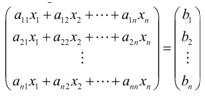
1410_Systems of Equations Revisited.png

The left side of such equation can be thought of like a matrix multiplication.
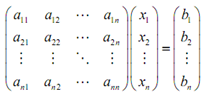
845_Systems of Equations Revisited1.png

Simplifying up the notation a little provides,

A x? = b?   ................................(2)

Now there, x? is a vector that elements are the unknowns in the original system of equations.

We take (2) the matrix form of the system of equations (1) and resolving (2) is equal to solving

(1). the solving process is identical. The augmented matrix for (2) is,

A(b?)

Once we contain the augmented matrix we proceed as we did along with a system which hasn't been wrote in matrix form.

We also have the subsequent fact regarding to solutions to (2).

Fact

Provided the system of equation (2) we contain one of the subsequent three possibilities for solutions.

1.   There will be no more solutions.

2.   There will be particularly one solution.

3.   There will be infinitely various solutions.

Actually we can go a little farther here. Because we are assuming that we've got similar number of equations like unknowns the matrix A in (2) is a square matrix and therefore we can calculate its determinant. This provides the following fact.

Fact

Provided the system of equations in (2) we have the subsequent.

1.   If A is nonsingular then there will be particularly one solution to the system.

2.   If A is singular then there will either be no solution or infinitely various solutions to the system.

The matrix form of a homogeneous system is as,

A x?= 0?

 Here 0? is the vector of all zeroes. Under the homogeneous system we are guaranteed to have a solutions, x? = 0?. The fact above for homogeneous systems is so, Fact

Given the homogeneous system (3) we contain the subsequent.

1.   If A is nonsingular then the only solution will be x? = 0?

2.   If A is singular then there will be infinitely many nonzero solutions to the system.


Related Discussions:- Systems of equations revisited

the volume of a pyramid, Write a script to determine the volume of a pyram...

Write a script to determine the volume of a pyramid, which is 1/3 * base * height, where the base is length * width.  On time the user to enter values for the length, width, and th

Logarithms, find any integer from 1-128 on a logarithmic scale

find any integer from 1-128 on a logarithmic scale

Eometyr, Lines EF and GH are graphed on this coordinate plane. Which point ...

Lines EF and GH are graphed on this coordinate plane. Which point is the intersection of lines EF and GH?

Permutation, A telephone dialled is numbered 0to9. if 0is dialled first the...

A telephone dialled is numbered 0to9. if 0is dialled first the caller is connected to the international exchange system.find the number of local calls that can be rung if a local n

The shape of a graph, The Shape of a Graph, Part II : In previous we saw h...

The Shape of a Graph, Part II : In previous we saw how we could use the first derivative of a function to obtain some information regarding the graph of a function.  In this secti

Derivatives of trig functions, Derivatives of Trig Functions In this s...

Derivatives of Trig Functions In this section we will see derivatives of functions other than polynomials or roots of polynomials. We'll begin this process off through taking

Unbounded intervals, Intervals which extend indefinitely in both the ...

Intervals which extend indefinitely in both the directions are known as unbounded intervals. These are written with the aid of symbols +∞  and -  ∞  . The various types

Taylor series, If f(x) is an infinitely differentiable function so the Tayl...

If f(x) is an infinitely differentiable function so the Taylor Series of f(x) about x=x 0 is, Recall that, f (0) (x) = f(x) f (n) (x) = nth derivative of f(x)

Calculate the volume and surface area of a sphere, Calculate the volume and...

Calculate the volume and surface area of a sphere: Calculate the volume and surface area of a sphere with r = 4".  Be sure to include units in your answer. Solution: V

Write Your Message!

Captcha
Free Assignment Quote

Assured A++ Grade

Get guaranteed satisfaction & time on delivery in every assignment order you paid with us! We ensure premium quality solution document along with free turntin report!

All rights reserved! Copyrights ©2019-2020 ExpertsMind IT Educational Pvt Ltd