Program implementing the conjugate gradient method, Electrical Engineering

Assignment Help:

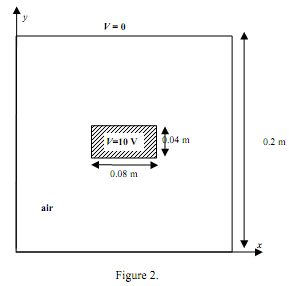
Write a program implementing the conjugate gradient method (un-preconditioned). Solve the  matrix equation corresponding to a finite difference node-spacing, h = 0.02m in x and y directions for the same one-quarter cross-section of the system shown in Figure. Use a starting solution of zero.

(a) Test your matrix using your Choleski decomposition program that you wrote for Question 1 of Assignment 1 to ensure that it is positive definite. If it is not, suggest how you could modify the matrix equation in order to use the conjugate gradient method for this problem.

(b) Once you have modified the problem so that the matrix is positive definite, solve the matrix equation first using the Choleski decomposition program from Assignment 1,and then the conjugate gradient program written for this assignment.

(c) Plot a graph of the infinity norm and the 2-norm of the residual vector versus the number of iterations for the conjugate program.

(d) What is the potential at (x,y) = (0.06, 0.04), using the Choleski decomposition and the conjugate gradient programs, and how do they it compare with the value you computed in Question 2(b) above. How do they compare with the value at the same (x,y) location and for the same node spacing that you computed in Assignment 1 using SOR.

(e) Suggest how you could compute the capacitance per unit length of the system from the finite difference solution.
506_Compute the capacitance.png


Related Discussions:- Program implementing the conjugate gradient method

Explain register direct and indirect data addressing mode, Explain Register...

Explain Register Direct and Indirect data addressing mode (with examples) available in microprocessors. Register Direct Modes and Register Indirect Modes: Does not giv

Simplify the following boolean expressions, Q. Using K maps, simplify the f...

Q. Using K maps, simplify the following Boolean expressions: (a) F = A · ¯ B + A · B (b) F = A · C + C · D + B · C · D (c) F = A·B · ¯ C +B ·C +A·B ·D +B ·C ·D

Compute sending - end voltage current and real power, Q. Athree-phase, 60-H...

Q. Athree-phase, 60-Hz transmission line has a total series impedance of 22.86 62.3°  per phase. It delivers 2.5 MW at 13.8 kV to a load connected to its receiving end. Compute th

Input offset current of operational amplifier, Q. Input offset current of o...

Q. Input offset current of operational amplifier? The adverse effect of the input bias current mentioned would be nulli?ed if both inputs were connected to equal resistances (o

Explain aas instructions in 8086 family, Explain AAS instructions in 8086...

Explain AAS instructions in 8086 family with example and their effect on flag. AAS: it is stands for ASCII adjust after subtraction; this is used to adjust the AX register l

Digital electronics, Design a recycling MOD 19 up counter using JK FFs. In ...

Design a recycling MOD 19 up counter using JK FFs. In your design, include the logic circuit diagram and the timing diagram output that counts from 000002 = 010 to 100112 = 1910. C

Zener breakdown voltage, (a) For the Zener diode series voltage regulator s...

(a) For the Zener diode series voltage regulator shown in the Figure. calculate V L , I Z , V R and P Z for R L = 1.2 KΩ and repeat it for R L = 3 KΩ ? Consider Zener breakdow

Semiconductors, Semiconductors Conductivity in among those of metal...

Semiconductors Conductivity in among those of metals and insulators. Conductivity can be changed over orders of magnitude through changes in temperature, optical excitat

Write Your Message!

Captcha
Free Assignment Quote

Assured A++ Grade

Get guaranteed satisfaction & time on delivery in every assignment order you paid with us! We ensure premium quality solution document along with free turntin report!

All rights reserved! Copyrights ©2019-2020 ExpertsMind IT Educational Pvt Ltd