Depth first search, Data Structure & Algorithms

Assignment Help:

DEPTH FIRST SEARCH (DFS)

The approach adopted into depth first search is to search deeper whenever possible. This algorithm frequently searches deeper through visiting unvisited vertices and whenever an unvisited vertex is not determined, it backtracks to earlier vertex to find out whether there are yet unvisited vertices.

As seen, the search described above is inherently recursive. We can determine a very simple recursive process to visit the vertices within a depth first search. The DFS is more or less alike to pre-order tree traversal. The procedure can be described as below:

Begun from any vertex (source) in the graph and mark it visited. Determine vertex that is adjacent to the source and not earlier visited via adjacency matrix & mark it visited. Repeat this procedure for all vertices that is not visited, if vertex is determined visited in this procedure, then return to the earlier step and begin the same process from there.

If returning back toward source is not possible, then DFS from the originally chosen source is complete and begin DFS using any unvisited vertex.
1686_DEPTH FIRST SEARCH.png

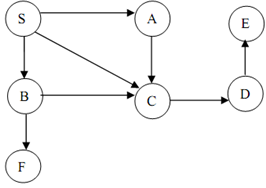
Figure: A Digraph

Let the digraph of Figure. Begun with S and mark it visited. Then visit the next vertex A, after that C & then D and finally E. Now there are no adjacent vertices of E to be visited next. Thus, now, backtrack to earlier vertex D as it also has no unvisited vertex. Now backtrack to C, then A, finally to S. Now S has an unvisited vertex B.

Begun DFS with B as a root node and then visit F. Now all of the nodes of the graph are visited.

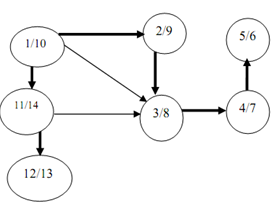
Figure shows a DFS tree with a sequence of visits. The first number mention the time at which the vertex is visited first and the second number mention the time upon which the vertex is visited throughout back tracking.
386_DEPTH FIRST SEARCH1.png

Figure: DFS tree of digraph of above figure

The DFS forest is illustrated with shaded arrow in  above Figure.


Related Discussions:- Depth first search

Sort wars - sorting algorithm, If quicksort is so quick, why bother with an...

If quicksort is so quick, why bother with anything else? If bubble sort is so bad, why even mention it? For that matter, why are there so many sorting algorithms? Your mission (sho

Determine the output of vehicles algorithm, Draw trace table and determine ...

Draw trace table and determine the output from the below flowchart using following data (NOTE: input of the word "end" stops program and outputs results of survey):  Vehicle = c

State an algorithm which inputs 3 - digit code for 280 items, A small shop ...

A small shop sells 280 different items. Every item is identified by a 3 - digit code. All items which start with a zero (0) are cards, all items which start with a one (1) are swee

Complexity of an algorithm, An algorithm is a sequence of steps to solve a ...

An algorithm is a sequence of steps to solve a problem; there may be more than one algorithm to solve a problem. The choice of a particular algorithm depends upon following cons

Define null values, Define null values.  In some cases a particular ent...

Define null values.  In some cases a particular entity might not have an applicable value for an attribute or if we do not know the value of an attribute for a particular entit

Stack, implement multiple stacks ina single dimensional array. write algori...

implement multiple stacks ina single dimensional array. write algorithams for various stack operation for them.

Calculates partial sum of an integer, Now, consider a function that calcula...

Now, consider a function that calculates partial sum of an integer n. int psum(int n) { int i, partial_sum; partial_sum = 0;                                           /* L

Circular linklist, write an algorithm to insert an element at the beginning...

write an algorithm to insert an element at the beginning of a circular linked list?

Algorithm for sorting a deck of cards, What is wrong with the following alg...

What is wrong with the following algorithm for sorting a deck of cards (considering the basic properties of algorithms)? I. Put the cards together into a pile II. For each ca

Write Your Message!

Captcha
Free Assignment Quote

Assured A++ Grade

Get guaranteed satisfaction & time on delivery in every assignment order you paid with us! We ensure premium quality solution document along with free turntin report!

All rights reserved! Copyrights ©2019-2020 ExpertsMind IT Educational Pvt Ltd