Computation of a dfa or nfa, Theory of Computation

Assignment Help:

Computation of a DFA or NFA without ε-transitions

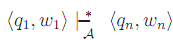
An ID (q1,w1) computes (qn,wn) in A = (Q,Σ, T, q0, F) (in zero or more steps)
2490_Computation of a DFA or NFA.png

if there is a sequence of IDs (q1,w1), . . . qn,wn)) in which, for all i > 1, 899_Computation of a DFA or NFA1.png

A computation of an FSA A on input w is a computation from the initial ID (q0,w) to a terminal ID: ((q0,wi, . . . , (q, ε)).

The fact that |-A is no longer partial functional implies that we can no longer speak of the computation of A on hq1,w1i. What's more, while every computation is ?nite, it is no longer true that they all take exactly |w1| steps. Computations end when they reach an ID with no successor; this can now be either because the entire input was scanned or because an ID hq, σ  wi was reached for which δ(q, σ) = ∅. Only the ?rst case represents successful processing of w1 by A; we need to be careful to distinguish "halting" computations from those that "crash".


Related Discussions:- Computation of a dfa or nfa

Graph Connectivity, Let G be a graph with n > 2 vertices with (n2 - 3n + 4)...

Let G be a graph with n > 2 vertices with (n2 - 3n + 4)/2 edges. Prove that G is connected.

D c o, Prove xy+yz+ýz=xy+z

Prove xy+yz+ýz=xy+z

Pendulum Swings, how many pendulum swings will it take to walk across the c...

how many pendulum swings will it take to walk across the classroom?

Can you help me in automata questions, i have some questions in automata, c...

i have some questions in automata, can you please help me in solving in these questions?

TRANSPORTATION, DEGENERATE OF THE INITIAL SOLUTION

DEGENERATE OF THE INITIAL SOLUTION

Pumping lemma constant, a) Let n be the pumping lemma constant. Then if L i...

a) Let n be the pumping lemma constant. Then if L is regular, PL implies that s can be decomposed into xyz, |y| > 0, |xy| ≤n, such that xy i z is in L for all i ≥0. Since the le

Pumping lemma, For every regular language there is a constant n depending o...

For every regular language there is a constant n depending only on L such that, for all strings x ∈ L if |x| ≥ n then there are strings u, v and w such that 1. x = uvw, 2. |u

Write Your Message!

Captcha
Free Assignment Quote

Assured A++ Grade

Get guaranteed satisfaction & time on delivery in every assignment order you paid with us! We ensure premium quality solution document along with free turntin report!

All rights reserved! Copyrights ©2019-2020 ExpertsMind IT Educational Pvt Ltd