What is the interference, Physics

Assignment Help:

What is the Interference?

A single frequency light passing through a pair of closely spaced slits will show a pattern of vertical bands, due to alternating constructive and destructive interference between the coherent light from the two slits. Constructive interference and the resulting bright band happens when the difference between the path from one slit and from the other is  λ, 2λ, 3λ, 4λ, etc. A dark band, due to destructive interference, happens when the path difference is λ, 3/2λ, 5/2λ, 7/2λand so on.
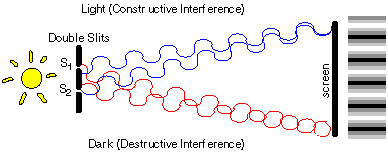
377_Interference 1.png

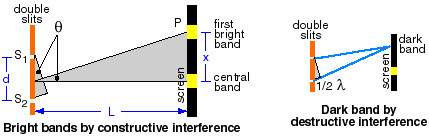
The wavelength of the light can be calculated from the distance between the center and the first bright band on the screen.
581_Interference 2.png

The length of light path S1P and the light path S2P must have a difference of one λ in order to have constructive interference. If L, the distance to the screen, is much larger than d, the distance between the slits, so that θ is very small and θ is about equal to sin θ:

Sin θ = X/L = λ/d so that λ = d (X/L)

where θ is the angle between the central and first bright band, λ is the wavelength of the light,  x is the distance along the screen to the first bright band, d is the distance between the two slits, and L is the distance from the slits to the screen.

Moire patterns, which are the changing patterns you see when you overlap two transparencies with thin stripes, are a consequence of interference. You can see them when you look through two chain link fences as you pass them in a car.

In various thicknesses of thin films, different colors of light are able to constructively interfere when the path difference between light reflected from the top surface and from the bottom surface matches the light's wavelength, causing the changing stripes of color we see in soap bubbles, the thin films of oil on puddles, and the colored bands on a CD. A layer of thickness, t, of ink is placed on the CD surface and then ruled with concentric circles of information. As you view the reflection at larger angles, the path difference becomes larger and a longer wavelength of light will be able to constructively interfere as well, and more bands of color will appear.

Newton's rings are a very precise way to measure the curvature or flatness of a piece of glass. The light reflecting from the bottom of the lens interferes with the light from the top of the flat glass plate, creating concentric rings.


Related Discussions:- What is the interference

What is the dynamic resistance, A coil of inductance 100 mH and resistance ...

A coil of inductance 100 mH and resistance 800Ω is connected in parallel with a variable capacitor across a 12V, 5kHz supply. Determine for the condition when the supply curre

Time of flight, projectile down an inclined plane

projectile down an inclined plane

Explain plane transmission grating, In plane transmission grating the width...

In plane transmission grating the width of the each slit is same to half of the opaque portion. Which order of spectra will be absent?

Watt, Watt; W (after J. Watt, 1736-1819): The derived SI unit of power...

Watt; W (after J. Watt, 1736-1819): The derived SI unit of power, explained as a power of 1 J acting onto a period of 1 s; thus it has units of J/s.

Calculate the longest wavelength, Q Calculate the longest wavelength that c...

Q Calculate the longest wavelength that can be analysed by a rock salt crystal of spacing d = 2.82 Ao in the first order. Data: d = 2.82 Å = 2.82 × 10⁻¹⁰ m; n = 1 ; λmax = ?

Charging a solar cell, Charging: During charging the device is linked acro...

Charging: During charging the device is linked across a source of D.C. supply having a voltage of about 3 volts. When the circuit is switched on the current flows inside the cell

Types of light in order from lowest to highest frequency, Question Pu...

Question Put the different types of light in order from lowest frequency to highest frequency. Feedback: These are all instances of electromagnetic radiation. Elect

What are characteristics of an ideal operational amplifier, What are differ...

What are different characteristics of an ideal operational amplifier?  Ans: Characteristics of an ideal Operational Amplifier: (1) Infinite voltage gain A (2) Infinite

MODERN OPTICS, DERIVATION OF ANGLE OF DEVITAION

DERIVATION OF ANGLE OF DEVITAION

Write Your Message!

Captcha
Free Assignment Quote

Assured A++ Grade

Get guaranteed satisfaction & time on delivery in every assignment order you paid with us! We ensure premium quality solution document along with free turntin report!

All rights reserved! Copyrights ©2019-2020 ExpertsMind IT Educational Pvt Ltd