Vitamins, Science

Assignment Help:

Vitamins:

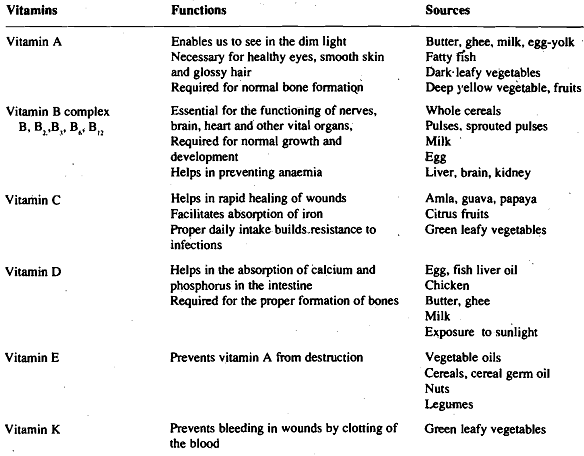
You are, probably, familiar with the names of some of the vitamins. They can be obtained from plant and animal foods. Vitamins are required in small amounts and their prolonged deficiency in food results in various diseases. In order to correct this situatibn, sometimes vitamins have to be giyen as tonics or medicine. Vitamins are  not a source of energy themselves but they help in the release of energy from carbohydrates, and fats. Therefore, food must contain required amounts of vitamins. There are various types of vitamins. A particular vitaminpr a group of two or more vitamins, protect the health and assist in the work of a particular organ of our body. Each vitamin has a specific function and cannot sabstitute for another. Table lists various vitamins,  their sources and functions. Vitamin A is needed for healthy eyes, smooth skin and glossy hair. Many children go blind in our country because of vitamin A deficiency. This could be easily prevented, because foods containing vitamin A, like carrots and green vegetables, are easily available. You will notice that vitamins of  the B group have many sub-groups. These have different  functions but  their source is more or less the same. Sometimes children or even'adults complain of  lack of appetite. They never seem to be hungry for meals. This is due to the deficiency of vitamin B group, which leads to undernutrition and retardatiop of growth.  
2081_viltamins.png

Vitamin C is present in fresh fruits and vegetables, especially in citrus fruits and guava. It is essential  for  the health of the mucous membrane which lines our mouth, nose and inner organs. It helps in building resistance against infections  like common cold. Vitamin D, which is present in eggs, milk, butter, etc., helps in proper formation of bones. Its deficiency leads to weak bones or physical deformities like bow  legs in children. This is the only vitamin which our body can make in the skin, by  the action of sunlight which  is plenty in India and costs nothing. Vitamin D is also called "sunshine vjtamin".  Fig. shows various foods rich in vitamin C.  

We should know that vitamins B and C are water sohble. Therefore,  they cannot be retainedin  the body and should be included in our daily meals. Other vitamins are not water soluble.  


Related Discussions:- Vitamins

Role of antibody mediated immune system, Role of Antibody Mediated Immune S...

Role of Antibody Mediated Immune System The AMlS defends the body against free viruses, bacteria with polysaccharide capsules and toxins that enter the body fluids (blood and l

Venus-the clouded planet, Venus-the Clouded Planet Venus, our nearest p...

Venus-the Clouded Planet Venus, our nearest planetary neighbour, only 40 million km away, has its surface hidden from view by a dense yellowish-white cloud, which extends to 80

Define fats - nutritional components, Define Fats - Nutritional Components ...

Define Fats - Nutritional Components Once the body stops eating, it begins to live on its fat. Fat storing depots 'adipocytes' are located in the different parts of the body. I

Plants making food, What process do plants build up carbohydrates by?

What process do plants build up carbohydrates by?

Find the angle of incidence, a ray of light falls on a transparent slab of ...

a ray of light falls on a transparent slab of refractive index u.if the reflected and refracted rays are mutually perpendicular to each other,find the angle of incidence.

Sasasa, what types of birds are there

what types of birds are there

What are the cultural practices, What are the Cultural Practices    Con...

What are the Cultural Practices    Continuous cultivation of a single crop (monoculture) over years at the same site cause s accumulation of a particular group of microbes whic

Friction, (friction is necessery evil)

(friction is necessery evil)

Objectives radiation and chemical hazards, Objectives After studying th...

Objectives After studying this unit, you should be able to: 1.  Categorise different radiations into ionising and no ionising types, 2.  Explain the effects of radiations

Changes in social organisation, Changes in Social Organisation: We find ...

Changes in Social Organisation: We find that the above trend in  social organisation  led to a tendency which eventually stifled the progress of  these civilisations and led to

Write Your Message!

Captcha
Free Assignment Quote

Assured A++ Grade

Get guaranteed satisfaction & time on delivery in every assignment order you paid with us! We ensure premium quality solution document along with free turntin report!

All rights reserved! Copyrights ©2019-2020 ExpertsMind IT Educational Pvt Ltd