Using pythagorean theorem solve z 2 = ( x + y )2 + 3502, Mathematics

Assignment Help:

Two people on bikes are at a distance of  350 meters.  Person A begin riding north at a rate of 5 m/sec and 7 minutes later on Person B begin riding south at 3 m/sec.  Determine the rate of the distance separating the two people changing 25 minutes after Person A begin riding?

Solution

There is a many digest here along this problem.  Let's begin with a sketch of the situation.
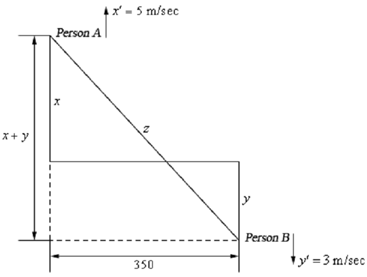
718_Pythagorean theorem.png

Now we are after z′ & we know that x′ =5 & y′ = 3 .  We desire to know z′ after Person A had been riding for 25 minutes & Person B has been riding for 25 - 7 = 18 minutes.  After turning these times to seconds (Since our rates are all in m/sec) it means that at the time we're interested in each bike riders has rode,

 x = 5 ( 25 × 60) = 7500 m                   y = 3(18 ×60) = 3240 m

Next, using Pythagorean theorem

z 2  = ( x + y )2 + 3502

Hence, 25 minutes after Person A begin riding the two bike riders are

277_pythagorem theorem.png

apart.

To find out the rate at which the two riders are moving separately all we have to do then is differentiate (2) and plug in all the quantities which we know to determine z′ .

2zz′ = 2 ( x + y ) ( x′ + y′)

2 (10745.7015) z′ = 2 (7500 + 3240) (5 + 3)

z′ = 7.9958 m/sec

Thus, the two riders are moving separately at rate of 7.9958 m/sec.


Related Discussions:- Using pythagorean theorem solve z 2 = ( x + y )2 + 3502

Solve-|x2-5x+4/x2-4|

x^2-5x+4 can written in roots as (x-1)*(x-4) x^2-4 can be written interms of (x-2)(x+2).so [(x-1)(x-4)/(x-2)(x+2)]

E is irrational, If e were rational, then e = n/m for some positive integer...

If e were rational, then e = n/m for some positive integers m, n. So then 1/e = m/n. But the series expansion for 1/e is 1/e = 1 - 1/1! + 1/2! - 1/3! + ... Call the first n v

Percentage, a washing machine costs $640 plus an installation charge of 7.5...

a washing machine costs $640 plus an installation charge of 7.5% what is the totalcost?

integral 0 to pi e^cosx cos (sinx) dx, Let u = sin(x). Then du = cos(x) dx...

Let u = sin(x). Then du = cos(x) dx. So you can now antidifferentiate e^u du. This is e^u + C = e^sin(x) + C.  Then substitute your range 0 to pi. e^sin (pi)-e^sin(0) =0-0 =0

Discrete math, ) Show that the following argument is valid: (~p ? q) =>...

) Show that the following argument is valid: (~p ? q) => r s ? ~q ~t p => t (~p ? r) => ~s ------------------------ ? ~q 2) Show that the following argum

Fundamental theorem of calculus, Fundamental Theorem of Calculus, Part I ...

Fundamental Theorem of Calculus, Part I As noted through the title above it is only the first part to the Fundamental Theorem of Calculus. The first part of this theorem us

Algebra, let setM={X,2X,4X} for any numberX .if average (arthemetic mean)of...

let setM={X,2X,4X} for any numberX .if average (arthemetic mean)of the number in setM is 14.what is the value of X?

Wholenumberriddles, I am less than 100 the sum of my digits is 4 half of me...

I am less than 100 the sum of my digits is 4 half of me is an odd number

Write Your Message!

Captcha
Free Assignment Quote

Assured A++ Grade

Get guaranteed satisfaction & time on delivery in every assignment order you paid with us! We ensure premium quality solution document along with free turntin report!

All rights reserved! Copyrights ©2019-2020 ExpertsMind IT Educational Pvt Ltd