Use of delay loops, Computer Engineering

Assignment Help:

A very useful application of assembly is to generate delay loops. These loops are used for waiting for some time before execution of subsequent instruction.

However how to find time for the delay? The rate at which instructions are executed is determined by clock frequency. Every instruction occupies a certain number of clock cycles to execute. This multiplied by clock frequency of microprocessor gives actual time of execution of an instruction. For illustration MOV instruction occupies four clock cycles. This instruction when run on a microprocessor with a 4 MHz clock occupies 4/4 which means 1 microsecond. NOP is an instruction which is used to produce the delay without affecting actual running of program.

Time-delay of 1 ms on a microprocessor having a clock frequency of 5 MHz will necessitate:
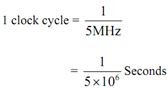
1419_Use of delay loops.png

Thus, a 1-millisecond delay will require:
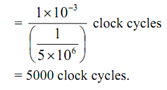
1588_Use of delay loops1.png

The subsequent program section can be used to produce the delay with counter value correctly initialised.

MOV CX, N    ; 4 clock cycles N will vary depending on

                        ; The amount of delay required

DELAY:         NOP                ; 3 cycles

                        NOP                ; 3 cycles

                        LOOP DELAY; 17 or 5

LOOP instruction occupies 17 clock cycles when condition is true and 5 clock cycles otherwise. Condition will be true 'N' number of times and false just once when control comes out of loop.

To calculate 'N':

  Total clock cycles    = clock cycles for MOV + N (2*NOP clock cycles + 17) - 12 (when CX = 0)

5000 = 4 + N (6 + 17) - 12 

 N = 5000/23 = 218 = 0DAh

So the counter CX must be initialized by 0DAh in order to get delay of 1 millisecond.


Related Discussions:- Use of delay loops

Explain about two-pass assembler, Q. Explain about Two-pass assembler? ...

Q. Explain about Two-pass assembler? Assemblers usually make two or more passes through a source program in order to resolve forward references in a program. A forward referenc

Which approaches not require knowledge of the system state, Which approache...

Which approaches do not require knowledge of the system state? Ans. Deadlock detection, deadlock prevention and deadlock avoidance; none of the given require knowledge of the s

Why io devices cannot be connected to the system bus, Why IO devices cannot...

Why IO devices cannot be directly be connected to the system bus? The IO devices cannot be directly linked to the system bus because i.  The data transfer rate of IO device

Measure of speed in page or line printer, Q. Measure of speed in Page or li...

Q. Measure of speed in Page or line Printer? Measure of speed relies on whether the printer is a Page Printer or Line. Printer: Let's understand these:  Line Printer:

Dna sequences, The dataset provided in this assignment contains a collectio...

The dataset provided in this assignment contains a collection of real DNA sequences. The number of true binding sites is quite limited and that makes the problem challenging. In ma

Define various applications of shift register, Lists out some applications ...

Lists out some applications of Shift Register. Ans: Applications of Shift Registers: a. Serial to Parallel Converter b. Parallel to Serial Converter c. Delay li

Develop an object-oriented design, Investigate the MIPS programmers model a...

Investigate the MIPS programmers model and develop an object-oriented design that will reflect aspects of the MIPS architecture. Consider the functional units of the architecture a

Sigmoid units-artificial intelligence, Sigmoid units - Artificial intellige...

Sigmoid units - Artificial intelligence Remember that the function inside units take as input the weighted sum, S, of the values coming from the units associated to it. The fun

Write Your Message!

Captcha
Free Assignment Quote

Assured A++ Grade

Get guaranteed satisfaction & time on delivery in every assignment order you paid with us! We ensure premium quality solution document along with free turntin report!

All rights reserved! Copyrights ©2019-2020 ExpertsMind IT Educational Pvt Ltd