The fire triangle, Science

Assignment Help:

The Fire Triangle

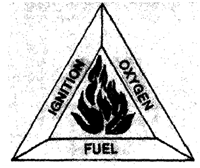
Generally, a fire needs three things to burn:

Fuel - something to bum, e.g.oi1.

Oxygen - to maintain combustion.

Ignition - something to start the fire, e.g. excessive heat, electrical spark, etc. This principle can be depicted in the form of a triangle as shown in Figure.
657_The fire triangle.png

Figure: The fire triangle.

By removing any one of the three sides of the triangle, fire is prevented. For example, many fires obtain oxygen from the air where it is about 20% by volume. Fire extinguishers, e.g. sand or foam (subsection 12.4.2), prevent oxygen being available to the fuel or ignition source. Although air is the most common source of oxygen, other sources are,

  • chlorates
  • permanganates
  • nitrates
  • peroxides
  • dichromates
  • other oxidising agents

The essence of fire prevention is to prevent the formation of fire triangle.

With air containing oxygen all around us, this consists primarily of keeping fuel and ignition sources apart.


Related Discussions:- The fire triangle

Determine about the chemical weathering, Determine about the Chemical weath...

Determine about the Chemical weathering Chemical weathering is accelerated by the presence of oxygen, and organic and inorganic acids resulting from the microbial breakdown of p

Properties of waves, how amplitude , wavelength , and frequency are relate...

how amplitude , wavelength , and frequency are related to the energy of a wave

Determine about the moisture content of soil, Moisture Content of Soil ...

Moisture Content of Soil As mentioned above the degree of moisture pertains to relative concentration (rather than the absolute amount) of water, independent of the size of sam

Explain the small intestine, Explain the Small Intestine The small inte...

Explain the Small Intestine The small intestine is continuous with the stomach at the pyloric sphincter and leads into the large intestine at the ileocdic valve.  It is about 2

Define the non-excretory functions of kidney, Define the Non-Excretory Func...

Define the Non-Excretory Functions of Kidney Though the major contribution of the kidneys, as you have learnt so far, is to form urine and to maintain the constancy of internal

.volcanism, what the different types of volcanoes are?

what the different types of volcanoes are?

Experiment to make soap, How to make soap Soap can be made from waste f...

How to make soap Soap can be made from waste fat. Secure some waste fats and melt in a dish. Strain the fat by several layers of cloth. Weigh the fat and then weigh out about o

What is a covalent crystal, What is a covalent crystal? A covalent crys...

What is a covalent crystal? A covalent crystal is one in which the lattice structure is held together by powerful covalent bonds. These crystals tend not to be soluble in water

Types of soils, Types of soils Secure samples of soil from as many plac...

Types of soils Secure samples of soil from as many places as possible and place in glass jars. Try to get examples of a sandy soil, a loam soil, a clay soil, a soil rich in dec

Psychology, discuss the special conflict that erikson believed marked young...

discuss the special conflict that erikson believed marked young adulthood. Then describe how an individual could best resolve this conflict

Write Your Message!

Captcha
Free Assignment Quote

Assured A++ Grade

Get guaranteed satisfaction & time on delivery in every assignment order you paid with us! We ensure premium quality solution document along with free turntin report!

All rights reserved! Copyrights ©2019-2020 ExpertsMind IT Educational Pvt Ltd