Tautologies, PL-SQL Programming

Assignment Help:

Tautologies:

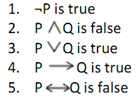
Above given table allows us to read the truth of the connectives in the next manner. Just expect we are looking at row three. It means this says that, if there P is false and Q is true, so 
1843_tautologies.png

Specified there that, if P is false, so regardless of where Q is true or false, and the statement P→Q is true. Thus this takes a little getting needed to, to be a very important tool in theorem proving: if there we know that there is something false, than it can imply anything we want it to! Just,, the follow next sentence is true: like "Barack Obama is female" it really implies that "Barack Obama is an alien", it means it the premise that Barack Obama is female was false, now the conclusion is Barack Obama is an alien can be deduced in a sound way. 

Each of row in a truth table describe the connectives are a particular assignment of true and false to the individual propositions in a sentence. So than we identify each assignment a model like: whenever it represents a particular possible state of the world. So, just for two propositions P and Q there are four models. 

Hence, for propositional sentences in generally, there a model is also just a particular assignment of truth values to its individual propositions. If there a sentence with n propositions will have 2n possible models than 2n rows in its truth table. But a sentence S will be true or may false for a given model M - where S is true we say 'M is a model of S'. 

Such type of sentences that are always true, regardless of the truth of the individual propositions are known as tautologies or can say valid sentences. There Tautologies are true for all models. Just like for instance, if I said that the "Tony Blair is prime minister or can say like Tony Blair is not prime minister" so there this is largely a content-free sentence it means that we could have replaced the predicate of being Tony Blair with any predicate so the sentence would still have been correct.


Related Discussions:- Tautologies

Parameter and keyword description - %type attribute, Parameter and Keyword ...

Parameter and Keyword Description: collection_name: This keyword identifies the index-by table, nested table, or varray formerly declared within the present scope. cu

Controlling cursor variables, Controlling Cursor Variables You use 3 s...

Controlling Cursor Variables You use 3 statements to control the cursor variable: OPEN-FOR, FETCH, & CLOSE. At First, you OPEN a cursor variable FOR a multi-row query. Then, y

Insert statement - syntax, INSERT Statement The INSERT statement adds f...

INSERT Statement The INSERT statement adds fresh rows of data to the specified database table or view. Syntax:

Using delete - collection method, Using DELETE This process has three ...

Using DELETE This process has three forms. The DELETE removes all elements from the collection. DELETE(n) removes the nth element from the nested table. When n is null, then D

Merge and truncate in sql, MERGE and TRUNCATE in SQL SQL has two more ...

MERGE and TRUNCATE in SQL SQL has two more table update operators, MERGE and TRUNCATE. MERGE, like INSERT, takes a source table s and uses it to update a target table t. Brief

Declaring cursor variables, Declaring Cursor Variables Once a REF CURS...

Declaring Cursor Variables Once a REF CURSOR type is define by you, and then you can declare the cursor variables of that type in any PL/SQL block or subprogram. In the exampl

Translate the given er schema into sql, Consider the schema for FreeCheckin...

Consider the schema for FreeChecking Bank, that we designed given below. Translate the given ER schema into SQL CREATE TABLE statements (indicating primary key, unique and foreign

Updating objects in pl sql, Updating Objects: To change the attributes...

Updating Objects: To change the attributes of objects in an object table, you can use the UPDATE statement, as the illustration below shows: BEGIN UPDATE persons p SET p

Calculate the number of tuples, Question: (a) The objective of query opti...

Question: (a) The objective of query optimization is to choose the most efficient strategy for implementing a given relational query, thereby improving the system performance. On

Collections in pl sql, Collections:   The collection is an ordered gr...

Collections:   The collection is an ordered group of elements, all of similar type (for illustration, the grades for a class of students). Each element has an exclusive subsc

Write Your Message!

Captcha
Free Assignment Quote

Assured A++ Grade

Get guaranteed satisfaction & time on delivery in every assignment order you paid with us! We ensure premium quality solution document along with free turntin report!

All rights reserved! Copyrights ©2019-2020 ExpertsMind IT Educational Pvt Ltd