Static electricity, Physics

Assignment Help:

Static electricity:

If electrons are removed from one material and placed on another, or if they are moved from one region of a piece of material to another, we have a separation of charge. The material, or area, that receives the electrons becomes negatively charged and the material or region that loses electrons becomes positively charged. If these accumulations of charge remain stationary after their transfer, they are referred to as static electricity.

Common examples of static electricity are the small shock you get when you touch a door handle having walked across a carpet, or the crackling you hear when you remove certain items of clothing. In both cases electrons have moved from one material to the other. This type of static charging between two or more dissimilar materials is known as triboelectric charging and is a very important factor in the design of aircraft and aircraft furnishings and equipment.

The nature and size of the charge produced depends on the materials, some loose or gain electrons more easily than others. The Triboelectric series on the next page list materials in the order in which they gain or loose electrons. The list is arranged such that, if any two materials are selected and rubbed together the one higher up the list will obtain a positive charge and the one lower down the list, a negative charge. So if a glass rod is rubbed with fur, the rod will become negatively charged, but if it is rubbed with nylon it will become positively charged.

When an insulating material is charged by rubbing it with another material, the electrons are not free to move through the material. The charge therefore remains at the point of friction. If a conductor is charged through rubbing, the electrons are free to move and the charge will dissipate unless the conducting material is insulated from its surroundings.

If two statically charged items are brought into contact with one another, electrons will transfer from the more negative to the more positive one. This movement of electrons constitutes a current flow, which will cease once the charges are equal.

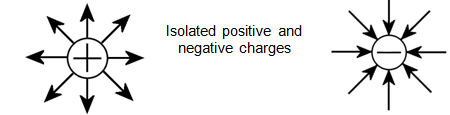
The region around the charged body may be detected and is called an electric field, the electric field is analogous to a magnetic field, which will be studied later in the course. The electric field is represented in magnitude and direction by electric lines of force. The density or magnitude of the force may be represented by the number of lines, and the direction is indicated by arrows that point from positive to negative.
1194_static electricity.png


Related Discussions:- Static electricity

Advantages of d.c. transmission of power, Advantages of D.C. transmission o...

Advantages of D.C. transmission of power  1. It needs only two conductors as compared to three for a.c. transmission. 2. There is not an inductance, capacitance, phase displ

Linear acceleration, The rope shown in the figure attached hereto is wound ...

The rope shown in the figure attached hereto is wound around a cylinder of of mass 4.0 kg, radius 10cm and I=0.020kgm2 , where I is the moment of inertia about an axis along the cy

Power, Power: The rate of doing work is called power, and it is defined...

Power: The rate of doing work is called power, and it is defined as the work done in unit time.  As a formula, this would be: power = work done/time Taken  Power is exp

Production of electricity by pressure, Production of electricity by pressur...

Production of electricity by pressure: Certain crystals and semiconductors produce an emf between two opposite faces when the mechanical pressure on them is either increased or

Entropy and second law of thermodynamics, Show that the heat transferred du...

Show that the heat transferred during an in nitesimal quasi-static process of an ideal gas can be written as dQ = Cv nR V dP + Cp nR PdV: Apply this equation to an adiabatic proces

What is free fall acceleration, What is free fall acceleration? On eart...

What is free fall acceleration? On earth free fall acceleration is 9.81 meters per second per second or 32.2 feet per second per second, not containing air resistance. Aroun

If a single force acts on an object, Q. If a single force acts on an objec...

Q. If a single force acts on an object, the object accelerates. yse it is definately true. Newton's second law.

ACTIVITY, IN SUCCESSIVE DISINTEGRATION WHY DOUGHTER ELEMENT NOT DECAY WHEN ...

IN SUCCESSIVE DISINTEGRATION WHY DOUGHTER ELEMENT NOT DECAY WHEN IT FORM BUT DECAY AFTER A FIEW TIME FROM ITS FORMATION

Explain newtons cradle, Explain newtons cradle- A typical Newton's cradle c...

Explain newtons cradle- A typical Newton's cradle consists of metal balls of identically sized in a series suspended in a metal frame ,so that they are just touching each other at

Explain Resonance, Resonance When the frequency of driving force become...

Resonance When the frequency of driving force become equal to the natural frequency of an oscillating system, the driving force provides maximum energy and the oscillating syst

Write Your Message!

Captcha
Free Assignment Quote

Assured A++ Grade

Get guaranteed satisfaction & time on delivery in every assignment order you paid with us! We ensure premium quality solution document along with free turntin report!

All rights reserved! Copyrights ©2019-2020 ExpertsMind IT Educational Pvt Ltd