Solid-state control of synchronous motors, Electrical Engineering

Assignment Help:

Solid-State Control of Synchronous Motors

 The speed of a synchronous motor can be controlled by changing its supply frequency. With variable-frequency control, two modes of operation are possible: true synchronous mode, employed with voltage source inverters, in which the supply frequency is controlled from an independent oscillator; and self-controlled mode, in which the armature supply frequency is changed proportionally so that the armature field always rotates at the same speed as the rotor. The true synchronous mode is used only in multiple synchronous-reluctance and permanent-magnet motor drives, in applications such as paper mills, textile mills, and fiber-spinning mills, because of the problems associated with hunting and stability. Variable-speed synchronous-motor drives, commonly operated in the self-controlled mode, are superior to or competitive with induction motor or dc-motor variable-speed drives.

Drives fed from a load-commutated current-source inverter or a cycloconverter find applications in high-speed high-power drives such as compressors, conveyors, traction, steel mills, and ship propulsion. The drives fed from a line-commutated cycloconverter are used in low-speed gearless drives for mine hoists and ball mills in cement production. Self-controlled permanent- magnet synchronous-motor drives are replacing the dc-motor drives in servo applications.

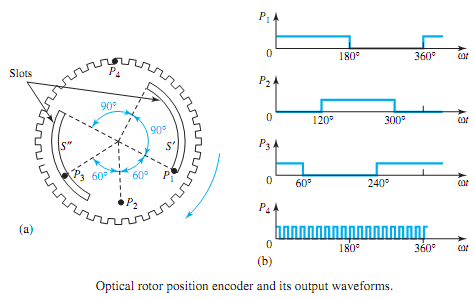
Self-control can be applied to all variable-frequency converters, whether they are voltage- source inverters, current-source inverters, current-controlled PWMinverters, or cycloconverters. Rotor position sensors, i.e., rotor position encoders with optical or magnetic sensors, or armature terminal voltage sensors, are used for speed tracking. In the optical rotor position encoder shown in Figure for a four-pole synchronous machine, the semiconductor switches are fired at a frequency proportional to the motor speed. A circular disk, with two slots S and S on an inner radius and a large number of slots on the outer periphery, is mounted on the rotor shaft. Four stationary optical sensors P1 to P4 with the corresponding light-emitting diodes and photo transistors are placed as shown in Figure. Whenever the sensor faces a slot, an output results.Waveforms caused by the sensors are also shown in Figure. A detailed discussion of this kind of microprocessor control of current-fed synchronous-motor drives is outside the scope of this text.
2190_Solid-State Control of Synchronous Motors.png


Related Discussions:- Solid-state control of synchronous motors

Write the kvl equation for the circuit, Q. Consider a reverse-biased diode ...

Q. Consider a reverse-biased diode with a source voltage VB in series with a load resistance RL. Write the KVL equation for the circuit.

Control system, what is the difference between the continuous time system ...

what is the difference between the continuous time system and discrete time system and their advnatages?

What do you mean by pipelining in an 8086 processor, What do you mean by pi...

What do you mean by pipelining in an 8086 processor? The computer is composed of two kinds that operate  asynchronously single part called a BIU in the 8086,fetches instruction

Find the per-unit voltage regulation, Q. A single-phase, 3-kVA, 220:110-V, ...

Q. A single-phase, 3-kVA, 220:110-V, 60-Hz transformer has a high-voltage winding resistance of 0.3 , a low-voltage winding resistance of 0.06 , a leakage reactance of 0.8  on i

Calculate the rated load current of machine, A 500 MVA, 33kv, three phase s...

A 500 MVA, 33kv, three phase steam turbine generator has a synchronous reactance of 1.6 p.u. It delivers a rated output at 0.8 power factor lagging. Calculate (a) The synchronou

Find the thevenin equivalent, Task 1 Use basic circuit theory to...

Task 1 Use basic circuit theory to convert the "T" circuit below into the equivalent "π". Hint: Remember to disconnect the voltage source and the load. Task 2

Explain computer-aided circuit analysis, Q. Explain Computer-aided circuit ...

Q. Explain Computer-aided circuit analysis? A word of caution is appropriate if this is the student's first experience with simulation. Just as the proliferation of calculators

Electricity and safety, explain appropriate first aid procedure to be follo...

explain appropriate first aid procedure to be followed in case of electric shock

Digital electronics logic family, For a given logic family, consider VOL = ...

For a given logic family, consider VOL = 0.25V and VOH = 5 V . For a given circuit, VIL = 0.96 V and VIH = 2.18 V. Find the largest positive-going and largest negative-going nois

Write Your Message!

Captcha
Free Assignment Quote

Assured A++ Grade

Get guaranteed satisfaction & time on delivery in every assignment order you paid with us! We ensure premium quality solution document along with free turntin report!

All rights reserved! Copyrights ©2019-2020 ExpertsMind IT Educational Pvt Ltd