Relative costs and benefits, Financial Management

Assignment Help:

Q. Relative costs and benefits?

Option 1- Factoring

Reduction in receivables days = 15 days

Reduction in receivables =15/365* £20m

= £821916
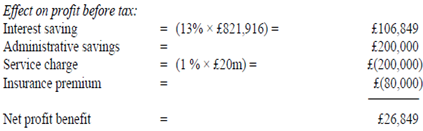
2101_Relative costs and benefits.png

Option 2 - The discount

With year-end receivables at £4.5m the receivables collection period was

£4.5m/£20m × 365 = 82 days

The scheme of discounts would change this as follows

10 days for 20% of customers

20 days for 30% of customers

82 days for 50% of customers

Average receivables days becomes

(20% * 10) + (30% * 20) + (50% * 82) = 49 days

The cost of the discount would be:

(3% * 20% * $20m) + (1.5% * 30% * £20m) = (£210000)

Consequently average receivables would reduce from the present $4.5rri to 49 × (£20m-£0.21m)/365 = £2656740

The interest saving would be 13% × £4.5m - £2.657m) = £239590

The net advantage to profit before tax would be

(£239590 - £210000) = £29590

The figures involve that submission settlement discounts is somewhat the more attractive but this result relies on the predicted proportions of customers in fact taking up the discount and paying on time. It as well abandons the possibility that some customers will insist on taking the discount without bringing forward their payments. Marton would have to consider a suitable response to this problem.

In contrast the assessment of the value of using the factor depends on the factor lowering Marton's receivables days. If the factor remains these benefits for itself rather than passing them on to Marton, this will elevate the cost of the factoring option. Additionally it isn't clear what benefit the insurance premium gives Marton.


Related Discussions:- Relative costs and benefits

Interest rates, Interest Rates The payment borrowers make for the use o...

Interest Rates The payment borrowers make for the use of the funds that they borrow and the payment that lenders demand for the use of the funds they lend (termed interest ) w

What are the weaknesses of the traditional approach, What are the Weaknesse...

What are the Weaknesses of the traditional approach The traditional approach to the scope of finance function evolved during 1920s and 1930s and dominated academic during 40's

Yield to put, Yield to put is the rate at which the present val...

Yield to put is the rate at which the present value of cash flow to the first put date is equal to the price plus interest rate. It is used for

Dividend payout ratio, Dividend Payout Ratio The percentage of earnings...

Dividend Payout Ratio The percentage of earnings or profit paid to shareholders in dividends. Computed as:   The payout ratio gives an idea about how well earning

Important features floating rate notes, Reference Index Every FRN choos...

Reference Index Every FRN chooses its own reference index upon which the calculation of each successive new coupon is based. The most commonly used reference index is LIBOR. It

Long-term solvency ratios (financial leverage ratios), Long-Term Solvency R...

Long-Term Solvency Ratios (Financial Leverage Ratios)   Debt-Equity Ratio = Total Debt / Total Equity à It is a measure of a company's debt utilization. It gives the ex

Explain the political risk related with making fdi, What factors would you ...

What factors would you consider in evaluating the political risk related with making FDI in a foreign country? Answer: Factors to be considered as follow: a) The host countr

Financial statements of home retail group, Briefly outline the necessities ...

Briefly outline the necessities of the UK version of ISA 700/ 750/ 706 and discuss the factors which would manipulate you as the external auditor in forming an opinion on the finan

How to calculate rate of return?, Illustration Consider a Rs.1,00...

Illustration Consider a Rs.1,000 par value bond whose current market price is Rs.850. The bond carries a coupon rate of 8% and has a maturity period of 9 years. Wha

Regulatory aspect in employees provident fund organization, Regulatory Aspe...

Regulatory Aspect Employees Provident Fund Organization (EPFO) is under the Ministry of Labor and is a primary organization for retirement income for private employees in India

Write Your Message!

Captcha
Free Assignment Quote

Assured A++ Grade

Get guaranteed satisfaction & time on delivery in every assignment order you paid with us! We ensure premium quality solution document along with free turntin report!

All rights reserved! Copyrights ©2019-2020 ExpertsMind IT Educational Pvt Ltd