Quality improvement methodology, Other Management

Assignment Help:

Quality Improvement methodology

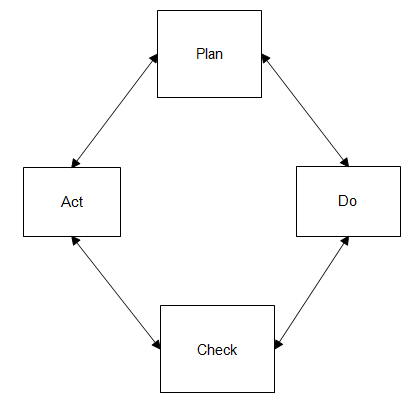
For   Quality   Improvement,   the   Plan-Do-Check-Act   cycle   approach   is generally  used.  The  PDCA  (Plan-Do-Check-Act)  cycle  also  called  the Deming cycle is as shown in the figure below:
669_plan do check act cycle.png

Figure : Plan-Do-Check-Act cycle

The Plan-Do-Check-Act (PDCA) cycle is as follows:

  • Plan: This is the beginning point where the process will have to be selected. This process if executed correctly indicates the greatest opportunity for success, at first; it may be useful to select the process which indicates the biggest potential for the successful improvement and also maybe the "easiest" one. The team may face less difficulty while working through the model the first time, and both the team and the management will be encouraged by the success. After selecting the right process, the change should be analysed and planned.
  • Do: This is the "action-oriented" step. The results can be critical for further quality improvement.
  • Check: This step observes the effect of the change. It is usually the careful and a comprehensive study of the results. The project team should fully understand the effects of the change and also understand its occurrence, and also how it may affect some other processes in the system.
  • Act: This is to check if the results are as expected and if they show the required beneficial effect, and also implement the change system-wide. The test case will show that the change might probably work as planned, so there will be little risk of knee-jerking the work force. This is a cycle which supports the continual improvement which signifies when to start the cycle again.

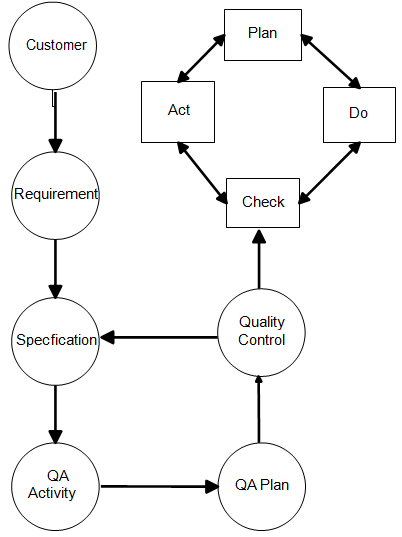
The quality life cycle consists of the customer, requirement, specification, quality assurance activity, quality assurance plan, quality control and PDCA and is as shown in the Figure 9.2.

1.  Customer - Customers are the base of the quality cycle and can be classified as internal, external and hidden.

2. Requirement - Customers are the sources of requirements. The requirements have to be full-filled for the project's success.

3.  Specification - Specifications have to be given by the customer in the contract or will be given informally by other customers.

4.  Quality assurance activity - Quality assurance is the application of planned  and  systematic  quality  activities  to  make  sure  that  all  the processes   required   for   the   project   are   employed    to   meet   the requirements.

5.  Quality assurance plan - Quality assurance plan documents all the activities and allows for the effective management.
1120_plan do check act cycle1.png

Figure : Quality Cycle

6.  Quality control - Quality control is used to check the quality of the deliverables with the application of complex tools.

7.  PDCA - Plan DO Check Act (PDCA) cycle is used to check the quality improvement.


Related Discussions:- Quality improvement methodology

Consulting and indents passing - library administration, Consulting: C...

Consulting: Consulting work can be done at prescribed  intervals or as and when needed for placing an  urgent order. For this purpose, subject lists are typed out from the car

Quality management, . During the analysis of a process that was evaluated, ...

. During the analysis of a process that was evaluated, a situation arose where it was seen that the variability of the data points collected was non-random on several occasions, i.

Evaluation of data, Evaluation of Data : The historical data  should b...

Evaluation of Data : The historical data  should be subjected  to  two  types  of  evaluation. External Criticism: Evaluation of data  is concerned with authenticity or g

Reprography unit in library building-library management, Reprography unit i...

Reprography unit in library building-library management With the advent of cheap and efficient photocopying machines, provision of photocopy service has become a must in most

Types of documentation and information centres, TYPES OF DOCUMENTATION AND ...

TYPES OF DOCUMENTATION AND INFORMATION CENTRES  Documentation and information centres are discussed here under three broad groups. They are:  i)  By ownership, i.e., those

Define learning organization, Question 1 What is change management? Explai...

Question 1 What is change management? Explain the importance of change management Question 2 Define Organisational Life Cycle. List and explain the stages in organizational L

Shelf arrangement - library management, Shelf Arrangement: Once the li...

Shelf Arrangement: Once the library has a taken decision on the number of sequences in which the total collection is to be organised the material in the shelf in each sequence

Identify main characteristics of a successful event, Question : (a) Des...

Question : (a) Describe what you understand by the term ‘events'? Identify the main types and categories of events supporting your answer with examples. (b) (i) Identify

Document accessioning - library management, DOCUMENT ACCESSIONING: All...

DOCUMENT ACCESSIONING: All the books and documents received in the  library are taken into its stock  by a process called Accessioning which involves the assignment of a seria

Write Your Message!

Captcha
Free Assignment Quote

Assured A++ Grade

Get guaranteed satisfaction & time on delivery in every assignment order you paid with us! We ensure premium quality solution document along with free turntin report!

All rights reserved! Copyrights ©2019-2020 ExpertsMind IT Educational Pvt Ltd