Propeller terminology, Other Engineering

Assignment Help:

PROPELLER TORQUE

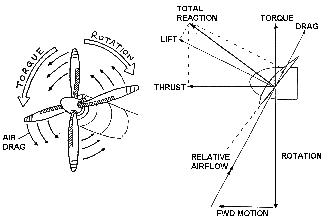
Propeller torque is produced by the aerodynamic drag on the blades when in motion. Propeller torque acts in the plane of rotation and opposes engine torque. When propeller torque and engine torque are equal the propeller will rotate at constant speed.
644_PROPELLER TERMINOLOGY.png 
BLADE FORCES

A propeller has to be capable of withstanding severe stresses that are greater near the hub and are caused by centrifugal forces and thrust. The force tending to through the blade from the hub is often as much as 22 tons. The stresses increase in proportion to the R.P.M. The blade face is also subjected to tension from the centrifugal force and additional tension from the bending. For these reasons, nicks or scratches on the blade can cause failure linked with stress corrosion.

BLADE RIGIDITY

A propeller must also be rigid enough to prevent flutter, a type of vibration in which the ends of the blade twist back and forth at high frequency around an axis perpendicular to the engine crankshaft. Flutter is often accompanied by a distinctive noise frequently mistaken for exhaust noise. The constant vibration tends to weaken the blade and may eventually cause failure.

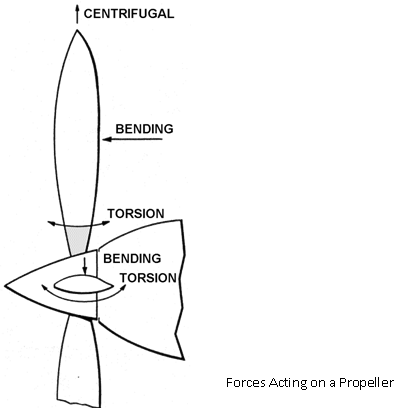
FORCES ACTING ON PROPELLER BLADES

• Bending - Due to thrust and torque forces on the blade.
• Centrifugal - Caused by the propeller blade mass rotating at high speeds.
• Torsion - Due to the affects of CTM and ATM (see pages1-7 &1-8) and pitch change loads.
• Thrust is the component acting at right angles to the plane of rotation.
• Torque is the component acting in the plane of rotation opposing engine torque and is the resistance offered by the propeller to rotation.
1655_PROPELLER TERMINOLOGY1.png

Thrust and Torque values developed by the propeller depend on the angle of attack, the R.P.M. and air density. As air density increases so will thrust, but as increased resistance is felt by the propeller, torque will also increase. Thrust and torque will alter in direct proportion to propeller speed and any increase in the Angle of Attack (below stalling speed) will produce more thrust and torque. There is an optimum angle of attack for all propellers, usually about 40.

The aerodynamic of the propeller can most easily be understood if the action of the propeller is considered. The motion is both rotational and forward, and as far as the forces are concerned, the result is the same as if the blade were stationery and the air were coming at it from a direction opposite its path. The air deflection produced by this angle causes the dynamic pressure at the engine side of the propeller blade (the blade face) to be greater, thus producing thrust.


Related Discussions:- Propeller terminology

High rise buildings - fire protection engineering, High rise buildings: ...

High rise buildings: High rise buildings have their own particular requirements for fire safety and for fire fighting.  Means of escape rely on most people descending the stai

Harriman, HARRIMAN MANUFACTURING COMPANY Harriman Manufacturing Company i...

HARRIMAN MANUFACTURING COMPANY Harriman Manufacturing Company is evaluating the purchase of a new piece of equipment. The quoted price is $50,000, and it would cost Harriman anot

Matlab codes for extended kalman filter, I would like to have simple matlab...

I would like to have simple matlab codes for measuring the changes in amplitude and frequency of pure sinusoidal signal in a disturbed environment and subsequently to show the resu

#pareto, how to crate pareto charts eith matlab?

how to crate pareto charts eith matlab?

Airflow control system principles-aircraft engine, Airflow control system p...

Airflow control system principles: For any given engine there is only one set of conditions, mass flow, pressure ratio and rpm, at which all the compressor components are opera

Enthalpy, What is the deference between enthalpy anne internal energy u

What is the deference between enthalpy anne internal energy u

Switching, name the switching schemes used in a digital exchange. how call ...

name the switching schemes used in a digital exchange. how call processing takes place?

Tubular joint fatigue, tubular joint root fatigue criteria and creteria abo...

tubular joint root fatigue criteria and creteria about tubular joint fatigue for inersid weld toe welded from both side

Grain growth, Q. Explain the grain growth. Ans. Grain growth: After R...

Q. Explain the grain growth. Ans. Grain growth: After Recrystallization is complete, the strain free grains will continue to grow if the metal specimen is left at elevated te

Servicing of chemical de-icing systems, SERVICING OF CHEMICAL DE-ICING SYST...

SERVICING OF CHEMICAL DE-ICING SYSTEMS: It is essential for the correct operation of the ice protection system that servicing is carried out on a regular basis.  The fluids use

Write Your Message!

Captcha
Free Assignment Quote

Assured A++ Grade

Get guaranteed satisfaction & time on delivery in every assignment order you paid with us! We ensure premium quality solution document along with free turntin report!

All rights reserved! Copyrights ©2019-2020 ExpertsMind IT Educational Pvt Ltd