Premium, Financial Management

Assignment Help:

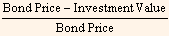
The amount by which the market price exceeds the conversion value or the investment value called the premium. When expressed as a percentage, it is given by,

         Conversion premium = (Market Price - Conversion value)/Conversion value x 100

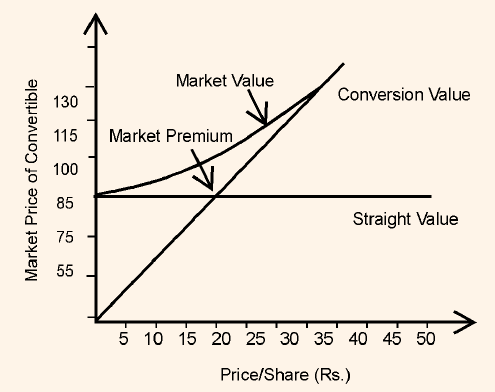
The conversion value can be lower than or greater than the investment value. Irrespective of this, the premium exists. This may be due to the investor's expectations that in future, the underlying stock may experience a price rise. These relationships can be better understood from Figure 1.

Figure 1
255_premium.png

From Figure 1, we observe that the investment value serves as a floor for the price of the convertible security, in a scenario of price decline of the underlying stock. When the market price of the stock exceeds certain value, the conversion value exceeds the investment value. The market value of the convertible security on most occasions exceeds its conversion value and investment value. The market premium is greatest at the point of intersection of the investment value and the conversion value.

In the above figure, we could understand the changes in the market price of the convertible with respect to conversion and investment values figuratively. If we express these relationships in relative terms, we have the following ratios:

Premium over Conversion Value = 432_premium1.png
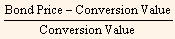
Premium over Investment Value = 532_premium2.png


Related Discussions:- Premium

Consistency in accounting, Consistency - ACCOUNTING postulate that stipulat...

Consistency - ACCOUNTING postulate that stipulates, except as otherwise noted in FINANCIAL STATEMENT, same accounting procedures and policies have been followed from period to peri

Fund raising and investment, Fund Raising and Investment: Fund commitme...

Fund Raising and Investment: Fund commitment requirement in Hedge Funds sometimes exceeds millions of dollars. In addition, high minimum investments are sometimes closed to new

Rating scale, Rating denote an issuer's ability to respond to adverse...

Rating denote an issuer's ability to respond to adverse changes in circumstances and economic conditions. The rating scale is generally differentiated into variou

Explain about routine functions, Q. Explain about Routine Functions? Ro...

Q. Explain about Routine Functions? Routine Functions: - The routine functions are Supervision of cash receipts and payments. Opening Bank Accounts as well as managing them Saf

Return payment method, when asked to calculate return method given cash flo...

when asked to calculate return method given cash flow before depreciation how do you do it

Evaluate the income statement, 2010 equity balance required: (600-20 - 2...

2010 equity balance required: (600-20 - 25 - 15 - 20)= 520 employees eligible Total expected equivalent value = 520 x 500 options x $1.48 = $384,800 $384,800 x 3/4 years = $28

Compute the weighted average cost of capital, Q. Compute the weighted avera...

Q. Compute the weighted average cost of capital? A company's subsequent to tax specific cost of capital are as follows: Cost of debt

Index amortizing notes (ina), In the Index Amortizing note, the princ...

In the Index Amortizing note, the principal is repaid according to an amortization schedule linked to a specific reference rate. It is structured in such a manner

Credit analysis of non-corporate bonds, Like corporate bonds, non-cor...

Like corporate bonds, non-corporate bonds such as asset-backed securities, mortgage-backed securities, municipal bonds, sovereign bonds are also exposed to credit

Write Your Message!

Captcha
Free Assignment Quote

Assured A++ Grade

Get guaranteed satisfaction & time on delivery in every assignment order you paid with us! We ensure premium quality solution document along with free turntin report!

All rights reserved! Copyrights ©2019-2020 ExpertsMind IT Educational Pvt Ltd