Moving the bar magnet rapidly away from the loop, Physics

Assignment Help:

Question:

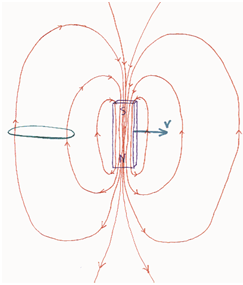
A wire loop smears in a horizontal plane. Alongside the loop is a vertical bar magnet south end up. The bar magnet is divide by the plane of the loop. A person is shifting the bar magnet rapidly away from the loop. What is the path of the current if any induced to flow in the loop?

Answer:

Refer to the diagram below:

1. The magnetic field lines expand out of the north end of a magnet and into the south end. (Nature of a bar magnet.)

2. With the north end of the magnet down as well as the loop beside the magnet as shown such magnetic field lines pass upward through the loop.

3. Magnetic field lines are more intimately packed close to the magnet than they are far from the magnet.

4. The motion of the magnet affects the loop to be farther and farther from the magnet as time goes by.

5. On the basis of 2, 3 and 4 above and the fact that a person is moving the bar magnet away from the loop the person is moving the magnet to the right in the diagram above while the loop stays put, the numerous upward magnetic field lines through the loop is decreasing with time.

6. By Faraday's Law the changing numerous magnetic field lines induces a current in the loop.

7. By Ampere's Law the encouraged current produces a magnetic field.

8. By Lenz's Law the magnetic field created by the induced current is upward to make up for the diminishing number of upward directed magnetic field lines from the magnet through the loop.

9. By the right-hand rule for something straight, something curly the induced current has to be counter clockwise in the loop as viewed from above in order to produce an upward-directed magnetic field.
466_Moving the bar magnet rapidly away from the loop.png


Related Discussions:- Moving the bar magnet rapidly away from the loop

Which bulb most efficiently changes electric energy to light, A manufacture...

A manufacturer of light bulbs advertises that its 55-W bulb, which produces 800.0 lm of light output, gives almost the similar light as a 60.0-W bulb with an energy savings. Th

Benefits of fiber-optic sensors for harsh environments, What are benefits o...

What are benefits of fiber-optic sensors for harsh environments? Benefits of fiber-optic sensors for harsh environments are illustrates below: a. Small, contact measurements

Damage of falling?, Is it determined by acceleration or velocity? Force or...

Is it determined by acceleration or velocity? Force or momentum?

Pauli exclusion principle, One of the most important theorems in the quantu...

One of the most important theorems in the quantum physics in the Pauli Exclusion Principle, which is based on the experiment observations. The principle explains that “No two elect

Illustrate de broglie waves, Q. What are de Broglie waves? Matter in m...

Q. What are de Broglie waves? Matter in motion should be accompanied by waves called de Broglie waves. de Broglie wavelength λ = h / mv

How can light be defined in simplest form, How can light be defined in simp...

How can light be defined in simplest form? The common explanation of 'light' (visible) is electromagnetic radiation visible to the human eye. It is only a little part of wha

Determine expression for the bound ray, A symmetric, multimode slab wavegui...

A symmetric, multimode slab waveguide has a core width 2ρ, a uniform cladding index n cl and a linear, graded-index profile n(x) in the core that is continuous and symmetric about

Explain n-type substances, N-Type Substances: When a small quantity of ...

N-Type Substances: When a small quantity of Arsenic or Phosphorous (group VA elements) is added to silicon or Germanium, it becomes good conductor of negative charges, such a s

Can lighting optic fiber to be spliced or joined, Can lighting optic fiber ...

Can lighting optic fiber to be spliced or joined? All fibers can be spliced along with difficulty and more or less success. The problem is the losses resulting from that a join

Kelvin, kelvin; K (after Lord Kelvin, 1824-1907): The basic SI unit of...

kelvin; K (after Lord Kelvin, 1824-1907): The basic SI unit of thermodynamic temperature explained as 1/273.16 of the thermodynamic temperature of the triple point of water.

Write Your Message!

Captcha
Free Assignment Quote

Assured A++ Grade

Get guaranteed satisfaction & time on delivery in every assignment order you paid with us! We ensure premium quality solution document along with free turntin report!

All rights reserved! Copyrights ©2019-2020 ExpertsMind IT Educational Pvt Ltd