Managing risk and contingency plan, Financial Management

Assignment Help:

Managing Risk and Contingency Plan:

An essential component of any financial management framework is the validation and protection of the information contained in the system. Internal controls provide one method where the accuracy of information can be assured.  Similarly, organisations should have in place systems designed to reduce the risk to the organisation's financial assets, and to secure the financial information itself.

An organisation must be aware of the various risks that exist within and around the organisation itself. In order to do so, organisations should engage in risk analysis and management processes.

Risk is present in any organisation.  A wise organisation will have in place processes for the identification and analysis of risk in all areas of the business.  Having identified these risks, the business would have in place procedures designed to either eliminate or reduce that risk, or where elimination / reduction is impossible alternative courses of action.

It is therefore essential that businesses make some attempt to assess risk. If an organisation does not know what risks are present they cannot take steps to avoid them.

The simplest form of risk management is an assessment of the probability of a particular event happening, against the impact that such an event would have on the business.  Probability is an estimate of the likelihood of the event occurring.  Impact is an assessment of the negative effect such an event would have on the business.

Combining these two factors is generally done as a process of statistical measurement, the outcome being a particular figure. These figures for the various events identified, would then be classified according to severity, thus allowing the organisation to devote resources in a more efficient manner (to those risks which represent the most serious).

The basic risk management process can be outlined as follows:
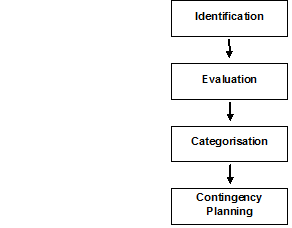
812_Managing Risk and Contingency Plan.png


Related Discussions:- Managing risk and contingency plan

State about the manufacturing overseas, State about the Manufacturing overs...

State about the Manufacturing overseas or exporting Dyson (appliances manufacturer) relocated UK production to Malaysia in 2002 though still retained its head office within the

Examine about the risk-based auditing, Examine about the Risk-based auditin...

Examine about the Risk-based auditing A risk based audit will be reviewing the risk management process and considering main risks of the organisation as a whole. Risk manage

Futures contract, Futures Contract It is an obligation to purchase or s...

Futures Contract It is an obligation to purchase or sell an asset at an agreed-upon price on an exact future date. The buyer commits himself or herself to buy the asset, and th

Currency denomination, The payment that the issuer makes to the bondh...

The payment that the issuer makes to the bondholder can be in any currency. The contract at the time of bond issue between the issuer and the investor can specify

Explain should a firm hedge and why or why not, Should a firm hedge?  Why o...

Should a firm hedge?  Why or why not? Answer:  Firms may not need to hedge exchange risk in a perfect capital market. But firms can add to their value by hedging if markets are

Show the current liabilities method, Q. Show the Current Liabilities Method...

Q. Show the Current Liabilities Method? Forecasting of Current Assets as well as Current Liabilities Method: - As-per to this method an estimate is made of forthcoming period's

Calculation of before-tax return on capital, Calculation of before-tax retu...

Calculation of before-tax return on capital employed Total net before-tax cash flow = 122 + 143 + 187 + 78 = $530000 Total depreciation = 250000 - 5000 = $245000 Average

Reinvestment income, Other than zero coupon bonds, all fixed in...

Other than zero coupon bonds, all fixed income securities make periodic payments in the form of coupon interest. This coupon interest can be rei

Create a financial institution’s balance sheet, Question. 1 Using D to...

Question. 1 Using D to assess the interest rate risk of a financial institution's balance sheet Background: Point 1. A business is 'insolvent' when it has negative eq

Explain about the valuing securities, Explain about the Valuing Securities ...

Explain about the Valuing Securities Objective of any investor is to maximise expected returns from his investments, subject to various constraints, primarily risk. Return is m

Write Your Message!

Captcha
Free Assignment Quote

Assured A++ Grade

Get guaranteed satisfaction & time on delivery in every assignment order you paid with us! We ensure premium quality solution document along with free turntin report!

All rights reserved! Copyrights ©2019-2020 ExpertsMind IT Educational Pvt Ltd