List mutation and shared structure, Python Programming

Assignment Help:

List mutation and shared structure

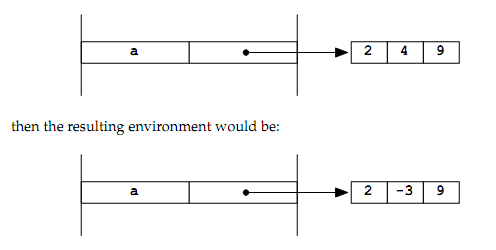
Lists are mutable data  structures, which defines  that  we can actually modifies  the values  stored in their components. We do this by using element-selection statement, like a[1] on the left-hand side of an assignment expression. So, the assignment

a[1] = -3

assigns  the  second  element of a to be -3.  In more  detail,  the  left-hand side  of this  expression
1630_List mutation and shared structure.png

We have permanently modified the list named a.

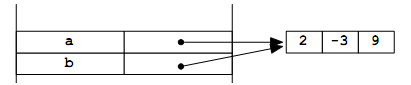
We will defines the consequences of the mutability of lists; programs that change list structure can become  very  confusing, but  you  can always work  your  way  through what  is happening by drawing out the memory diagrams.Continuing the previous samples, let us remind that  a is bound directly to a pointer to a list (or a sequence of memory cells), and think  about  what  occurs if we do:
886_List mutation and shared structure 2.png

Now,  we can reference parts  of the list through b, and even modifies  the list structure that way:


>>> b[0]

2

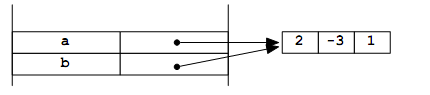
>>> b[2] = 1

Notice that, because  a and b point  to the similar list, modifying b changes a!
989_List mutation and shared structure 3.png

This situation is called  aliasing : the name  b has become  an alias  for a.  Aliasing may be useful, but  it may also cause  problems, because  you  can  inadvertently modify  b (by passing it into a procedure that changes one of its structured statement, for example) when  it is very important to you to keep a unmodi?ed.


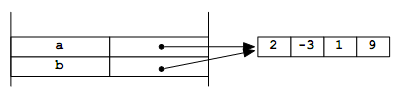
Another important way to change  a list is to add  or change  components. We will show adding elements to the end of a data structure, but look the Python documentation for more functions on lists. This statement
836_List mutation and shared structure 4.png


memory sequence), b is modified too. This is a side effect of the aliasing between a and b:

>>> b

[2, -3, 1, 9]

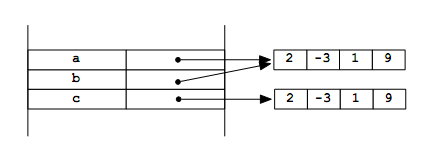
Often, it will be important to make a fresh copy of a list so that you can change it without affecting the  original one.   Here  are  two  similar types  to make  a copy  (use  whichever one  you  can remember):

>>> c = list(a)

>>> c = a[:]

Here is a sample of the memory at this position:
997_List mutation and shared structure 5.png


Now,  if we change  a component of c, it does not affect a (or b!):


>>> c[0] = 100

>>> c

[100, -3, 1, 9]

>>> a

[2, -3, 1, 9]

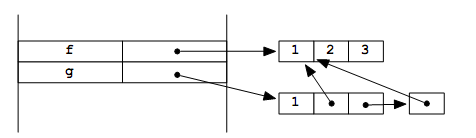
We can create crazy lists that share file within a single list:

>>> f = [1, 2, 3]

>>> g = [1, f, [f]]
472_List mutation and shared structure 6.png


If you want  to add  an element to a list and get a new copy at the similar time, you may do

>>> a + [1]

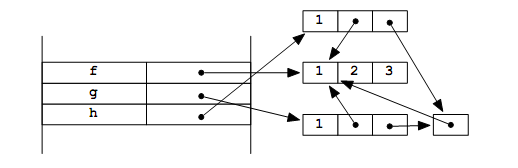
The + operator makes  a new list that contains the elements of both of its arguments, but does not give  any  top-level files.  All of our  functions of copying only work  reliably  if your  lists do not have other lists, because  it only copies single level of list. So example, if we did:
331_List mutation and shared structure 7.png

It is clear that if we were to modify  f, it would alter  h, so this is not a completely fresh copy.  If you have  to copy deep  structures, that  is, to create  a copy not only of the top level list structure, but  of the lists of any structures that  list has, and  the lists those  lists has,  etc., you  will have to use the Python copy.deepcopy method.


Related Discussions:- List mutation and shared structure

Structured assignment, Structured assignment Once  we have  tuples and...

Structured assignment Once  we have  tuples and lists, we may use  a nice trick  in assignment expression, based  on the packing and unpacking of tuples. >>> a, b, c = 1, 2

Work with functions, inputWithinRange (prompt, lowValue, highValue) This fu...

inputWithinRange (prompt, lowValue, highValue) This function will ask for a number using the prompt parameter. The function will only return a value that is within the inclusive ra

Range, Range Very frequently, we will want to iterate through a list o...

Range Very frequently, we will want to iterate through a list of integer values, often as indices.  Python gives a useful function, range, which gives lists of integers. It ma

Variables, Variables We cannot  go very far without variables. A variabl...

Variables We cannot  go very far without variables. A variable is a value related to a name that we can bind  to have a particular value  and  then  later use in an expression.

Packages and Libraries, For this assignment, you need to create a program t...

For this assignment, you need to create a program that allows the user to do basic trigonometry functions. First, ask the user if he or she would like to do sine, cosine, or tangen

Tuples and strings, Tuples  and strings Python has two different more...

Tuples  and strings Python has two different more list-like data  types  that are very important to understand.A tuple  is a structure that  is like a list, but  is not  mutab

Internal models, Internal models As we want to create  more and more c...

Internal models As we want to create  more and more complex  machine with  software programs as controllers, we search  that  it is often needful  to create  additional types

Basic-learning to program in python , Depending on your  previous programmi...

Depending on your  previous programming background, we use different sides  through the available readings:   If you have never programmed before: you should start with a

Small Viruses, I need how to write small kind of viruses...

I need how to write small kind of viruses...

Write Your Message!

Captcha
Free Assignment Quote

Assured A++ Grade

Get guaranteed satisfaction & time on delivery in every assignment order you paid with us! We ensure premium quality solution document along with free turntin report!

All rights reserved! Copyrights ©2019-2020 ExpertsMind IT Educational Pvt Ltd