Line generation algorithms - graphic primitives, Computer Graphics

Assignment Help:

Line Generation Algorithms - Graphic Primitives

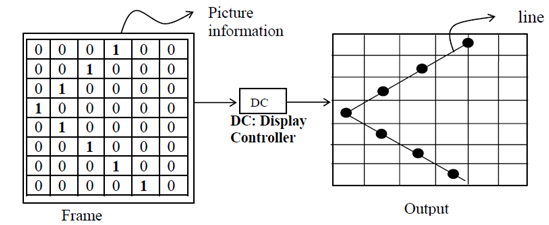
In previous section we have discussed the case of frame buffer, here information regarding the image to be projected upon the screen is accumulated in an m*n matrix, in the form of 0s and 1s; the 1s stored in an m* n matrix locations are brightened upon the display and 0's are not brightened on the display and this section that may or may not be brightened is termed as the Pixel i.e. picture element. This information of 0s and 1s offers the needed pattern on the output screen that is for display of information. In that a buffer, the screen is also in the form of m* n matrix, here all sections or niche is a pixel that is we have m* n pixels to constitute the output.
1184_Line Generation Algorithms - Graphic Primitives.png

Figure: Basic Line Generation

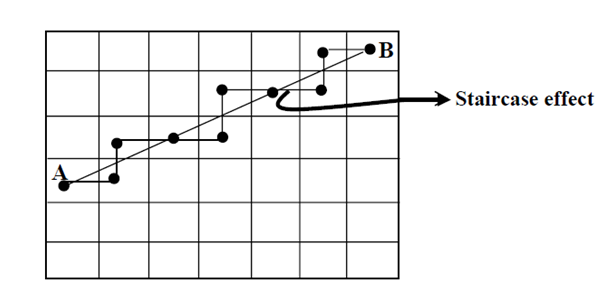
Here, it is to be noticed that the creation of a line is merely not restricted to the above pattern, since occasionally the line may have a slope and intercept which its information is needed to be stored in more than one part or section of the frame buffer, accordingly in order to draw or to estimated line two or more pixels are to be done ON. Thus, the result of the line information in the frame buffer is exhibited like a stair; this consequence of having two or more pixels ON to approximating a line among two points say A and B is termed as the Staircase effect. The idea is demonstrated below in following figure.
1666_Line Generation Algorithms - Graphic Primitives 2.png

Figure: Staircase effect

Hence, from the above figure, it is clear that while a line to be drawn is simply illustrated by its end points, after that it can be plotted through making close estimates of the pixels that best suit the line, and this estimation is responsible for the staircase consequence, that miss projects the information of the geometry of line accumulated in the frame buffer like a stair. This defect termed as Staircase consequence is prominent in DDA Line generation algorithms, hence, to remove the defect Bresenham line generation Algorithm was initiated. Now we are going to discuss DDA i.e. Digital Differential Analyzer, Algorithm and Bresenham line generation Algorithm next.


Related Discussions:- Line generation algorithms - graphic primitives

Reflection, Determine the transformation matrix for the reflection, Compute...

Determine the transformation matrix for the reflection, Computer Graphics

What is the feature of inkjet printers, What is the feature of Inkjet print...

What is the feature of Inkjet printers? Features of inkjet printers: They can print 2 to 4 pages/minutes. Resolution is about 360d.p.i. Thus better print quality is achie

Types of touch panels - input and output devices, Types of Touch panels ...

Types of Touch panels 1) Electrical TSS: Wire grid or the other conductive coating is utilized to specify a voltage drop at the point touched point from that the position ma

Graphics programming, Explain rubber-band interactive picture technique

Explain rubber-band interactive picture technique

What is a model sheet?, Question 1 Briefly explain the twelve principles o...

Question 1 Briefly explain the twelve principles of animation Question 2 Explain the methods to set-up pre and post-infinity curves Question 3 What is a model sheet? Exp

Intersection test - visible surface detection, Intersection Test - Visible ...

Intersection Test - Visible Surface Detection Test: It called Intersection Test also: we go for intersection test, if Min-max test fails. Now we take each edge individually

Write a c-code which generates a font interactively, Write a C-code which g...

Write a C-code which generates a font interactively.This means after every n mouse clicks, a Bezier curve is generated and then the terminal point of the last drawn Bezier curve is

What is fixed point scaling, What is fixed point scaling?  The location...

What is fixed point scaling?  The location of a scaled object can be controlled by a position known as the fixed point that is to remain unchanged after the scaling transformat

How many key frames does a one-minute animation film, How many key frames d...

How many key frames does a one-minute animation film order along with no duplications need? Solution : One minute = 60 seconds Number of frames needed per second=24 Numbe

Explain about the computer animation, Explain about the Computer animation ...

Explain about the Computer animation Computer animation is the art of creating moving images by computer software and hardware. For 3D animation, objects are designed on a

Write Your Message!

Captcha
Free Assignment Quote

Assured A++ Grade

Get guaranteed satisfaction & time on delivery in every assignment order you paid with us! We ensure premium quality solution document along with free turntin report!

All rights reserved! Copyrights ©2019-2020 ExpertsMind IT Educational Pvt Ltd