Lethal gene, Biology

Assignment Help:

LETHAL GENE (2:1 Instead of 1 : 2 : 1 or 3 : 1)

(i)         All the genes present in an organism are not useful, but some of them show harmful effects and sometimes may cause death or lethality. Such factors or genes which cause death or lethality in an organism are called lethal gene or factors.

(ii)         These lethal factors are fortunately present in recessive state and thus cause death only in homozygous condition. In heterozygous condition, they may cause structural changes.

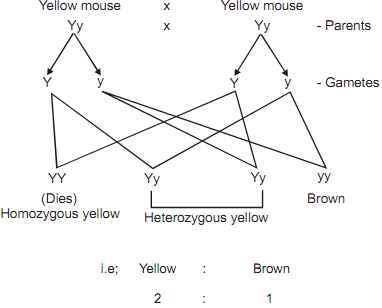
(iii)        Lethal factors were first of all reported in mice body colour by a French geneticist, L. Cuenot (1905). According to him, yellow mice never show true breeding and when yellow mouse is crossed with another yellow mouse, produce yellow and brown in the ratio of 2 : 1 (not 3 : 1). Yellow mouse is never present in homozygous condition.

(iv)        In the following example, 'Y' is a dominant gene for body colour but is recessive for lethality and when recessive genes come in homozygous condition, death is caused (i.e; YY - dies).
1213_lethal genes.png

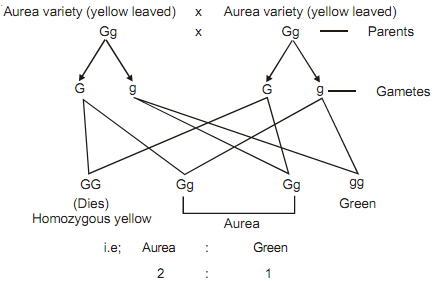
(v)         Lethal factors in case of plants were reported first of all in Snapdragons (Antirrhinum majus) by E. Baur (1907). (vi) In Snapdragons (Antirrhinum majus), yellow leaved (golden leaved) or 'aurea' variety never breeds true. When aurea variety is crossed with aurea, aurea and green are produced in the ratio of 2 : 1 (not 3 : 1) i.e. aurea is always heterozygous (Gg).
1469_lethal genes1.png

(vii)        Here again 'G' is dominant gene for yellow colour but is simultaneously recessive for lethality and when recessive gene come in homozygous condition, death is caused (i.e; GG - dies). 

Thus lethal factors cause modification of 3 : 1 ratio into 2 : 1.


Related Discussions:- Lethal gene

What are the chief complaint and patient expectations, Chief Complaint and ...

Chief Complaint and Patient's Expectations It is extremely vital to know what the patient really wants. 1. The chief complaint should be recorded in patient's own words as f

Define briefly the enzymatic proteins, Define Briefly the Enzymatic Protein...

Define Briefly the Enzymatic Proteins? The most varied and very highly specialized proteins are those along with catalytic activity - the enzymes. Virtually all the chemical re

How many bones in the human face, Explain how many bones in the human face?...

Explain how many bones in the human face? Ans) 14 bones are present in human face and these bones are known as sepio

Explain nutritional properties of the eggs, Explain nutritional properties ...

Explain nutritional properties of the eggs Drying of eggs under normal conditions causes little loss of the nutritional properties of the eggs. Vitamin A, vitamin B, thiamine,

Extracted chlorophyll pigments, Extracted chlorophyll pigments If we...

Extracted chlorophyll pigments If we take chlorophyll molecule in a test tube and provide 2 CO and water and expose the mixture to sunlight, glucose is not formed. If we

Molecular genetics and plant growth hormone, Molecular Genetics and Plant G...

Molecular Genetics and Plant Growth Hormone Molecular genetics has advanced over the last three decades by leaps and bounds, providing knowledge regarding the control of devel

Animals, explain the modes of nurition in animals

explain the modes of nurition in animals

Determine the occurrence of vitamin k, Determine the Occurrence of vitamin ...

Determine the Occurrence of vitamin K Vitamin K is found naturally in plants  and vitamin K2 is synthesized by the bacteria in the intestines in humans. In nature, only two nap

Zoology, two larva forms of sponge

two larva forms of sponge

Write Your Message!

Captcha
Free Assignment Quote

Assured A++ Grade

Get guaranteed satisfaction & time on delivery in every assignment order you paid with us! We ensure premium quality solution document along with free turntin report!

All rights reserved! Copyrights ©2019-2020 ExpertsMind IT Educational Pvt Ltd