Instruction formats-microprocessor, Assembly Language

Assignment Help:

Instruction Formats

A machine language instruction format has 1 or more number of fields linked with it. The first field is known as operation code field or op code field, which show the type of the operation to be performed by the CPU. The instruction format also has other fields known as operand fields. The CPU executes the instruction by using the information which reside in these fields.

There are 6 general formats of instructions in 8086 instruction set. The length of an instruction can vary from one byte to six bytes. The instruction formats are given as following:

1) One byte Instruction:  This format is just one byte long and can have theregister operands or  implied data . The least significant 3-bits of the op code are referring for specifying the register operand, if any. Or else all the 8-bits form an opcode and the operands are implied.

2) Register  to Register: This format is 2 bytes long. The first byte of the code indicatethe operation code and width of the operand indicated by w bit. The second byte of the code indicate the register operands and R/M field, as given below.

2261_instruction1.jpg

The register represented  by the REG field is 1 of the operands.  The R/M field indicate  another register or memory location, for example. the other operand.

3) Register to/from Memory with no Displacement:  This format is 2 bytes long and same as the register to register format except for the MOD field as shown.

460_instruction2.jpg

The MOD field indicates the mode of addressing. The R/M, MOD,REG and the W fields are decided inTable 3.2.

4) Register  to/from  Memory  with Displacement:  This type of instruction  format have  one or two extra bytes for displacement along with 2-byte the format of the register to/from memory without displacement. The format is given.

2109_instruction3.jpg

5) Immediate Operand to Register: In this format, the first byte and the 3-bits from the second byte which are utilized for REG field in case of register to register format are utilized for opcode. It also has one or two bytes of immediate data. The complete instruction format is as given below.

360_instruction4.jpg

6) Immediate Operand to Memory with 16-bit Displacement:  This type of instruction format requires 5 or 6 bytes for coding. The first 2 bytes have the information regardingMOD, OPCODE and R/M fields. The remaining 4 bytes have 2 bytes of displacement and 2 bytes of data as shown.
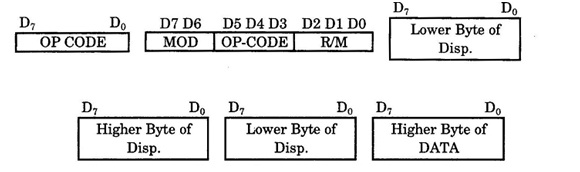
 

2472_instruction5.jpg


Related Discussions:- Instruction formats-microprocessor

Timing diagram of minimum mode, give the explaination of timing diagram min...

give the explaination of timing diagram minimum mode memory write cycle

Write an assembly language program, Your assignment for this project is to ...

Your assignment for this project is to write an assembly language program that checks if the user's input is a valid ISBN number. A sample run of your program might look like:

String manipulation instruction-microprocessor, String Manipulation Instruc...

String Manipulation Instruction A series of words or data bytes are available in memory at consecutive locations, to be mention to individually or collectively, are known as by

External system bus architecture-microprocessor, External System Bus Archit...

External System Bus Architecture : This is a 16 bit processor with 40 pins. It has twenty address pins and out of which sixteen are utilized as data pins. This concept of by us

Shell script, write shell to calculate basic salary from given .

write shell to calculate basic salary from given .

Rcr-rcl-logic instruction-microprocessor, RCR: Rotate Right through Carry:...

RCR: Rotate Right through Carry:- This instruction rotates the contents  bit-wise of the destination operand right by the specified count through carry flag (CF). For each operati

Shl, Assume that the registers are initialized to EAX=12345h,EBX =9528h EC...

Assume that the registers are initialized to EAX=12345h,EBX =9528h ECX=1275h,EDX=3001h sub AH,AH sub DH,DH mov DL,AL mov CL,3 shl DX,CL shl AX,1 add DX,AX

Name-offset-assemblers directive-microprocessor, NAME : Logical Name of...

NAME : Logical Name of a Module: The NAME directive which is used to assign a name to an assembly language program module. The modulecan now be mention to by its declared name.

Length-assemblers directive-microprocessor, LENGTH : Byte Length of a Labe...

LENGTH : Byte Length of a Label: This directive is not available in MASM. This is used to mention to the length of a data array or a string. MOV CX. LENGTH ARRAY This sta

Write Your Message!

Captcha
Free Assignment Quote

Assured A++ Grade

Get guaranteed satisfaction & time on delivery in every assignment order you paid with us! We ensure premium quality solution document along with free turntin report!

All rights reserved! Copyrights ©2019-2020 ExpertsMind IT Educational Pvt Ltd