Indirect utility functions, Microeconomics

Assignment Help:

Indirect Utility Functions:

Let qi denotes commodity i and pi is the price of that commodity. Let y denotes money income of the consumer. Suppose vi = pi/y. The budget constraint now may be written as  

854_Indirect Utility Functions.png

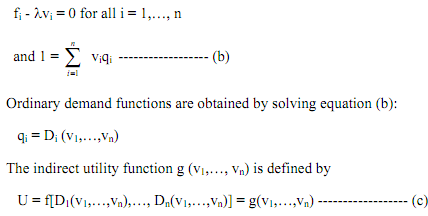
Since optimal solutions in the demand functions are homogeneous of degree zero in income and prices, nothing essential is lost by this transformation to "normalised" prices. The utility function U = f (q1, qn) together with equation (a) gives the following first order conditions of utility maximisation:   
1058_Indirect Utility Functions1.png

It gives the maximum utility as a function of normalised prices. The direct utility function describes preferences independent of market phenomena. The indirect utility function reflects a degree of optimisation and market prices. Applying the composite function rule of calculus to equation (c), we get  

1722_Indirect Utility Functions2.png

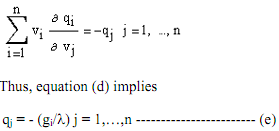
where the second equalities are based on equation (b). Partial differentiation of equation (a) with respect to vj yields  
2308_Indirect Utility Functions3.png

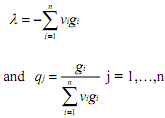
which is called the Roy's identity. Optimal commodity demands are related to the derivatives of the indirect utility function and the optimal value of the Lagrange multiplier (i.e., the marginal utility of income). Substituting equation (e) into the last equation of equation (b) gives  
2267_Indirect Utility Functions4.png

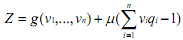
to provide an alternative form of Roy's identity. Now consider an optimisation problem in which equation (c) is minimised subject to equation (a) with normalised prices as variables and quantities as parameters. From the function, 1179_Indirect Utility Functions5.pngand setting its partials equal to zero, we get   
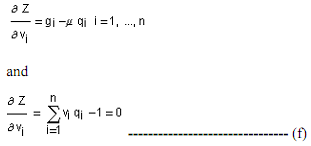
2390_Indirect Utility Functions6.png

"Inverse demand functions" are obtained by solving equation (f) for the prices as functions of quantities:  
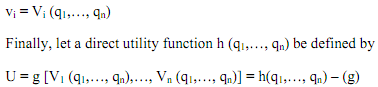
603_Indirect Utility Functions7.png

This provides a parallel to the direct problem in which quantities are variables and prices are parameters.  


Related Discussions:- Indirect utility functions

Advantage in cricket or food writing, Following the tremendous success of t...

Following the tremendous success of the 'Matthew Hayden Cookbook', we are once more welcomed into the home-and, more importantly, the kitchen!- of Australia's gourmet cricketer for

Theory of demand and utility, prove that the utility approach and the indif...

prove that the utility approach and the indifference curve yield the same consumer equilibrium.

Monopoly, if the inverse demand curve is p=120-Qand the marginal cost is co...

if the inverse demand curve is p=120-Qand the marginal cost is constant at 10, how does charging the monopoly a specific tax of 10 per unit affect the monopoly optimum and the welf

The production possibilities frontier (ppf), The Production Possibilities F...

The Production Possibilities Frontier (PPF) The PPF curve exhibits the probable combinations of goods and services accessible to an economy, given that all productive resources

Supply, Clearly explain the distinction between supply, demand and equilibr...

Clearly explain the distinction between supply, demand and equilibrium price.

Microeconomics, Define the concept of cross elasticity of demand

Define the concept of cross elasticity of demand

Write Your Message!

Captcha
Free Assignment Quote

Assured A++ Grade

Get guaranteed satisfaction & time on delivery in every assignment order you paid with us! We ensure premium quality solution document along with free turntin report!

All rights reserved! Copyrights ©2019-2020 ExpertsMind IT Educational Pvt Ltd