Index shift - sequences and series, Mathematics

Assignment Help:

Index Shift - Sequences and Series

The main idea behind index shifts is to start a series at a dissimilar value for whatever the reason (and yes, there are legitimate reasons for doing that).

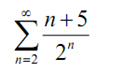
Consider the following series,
992_Index Shift - Sequences and Series 1.png

Assume that for some reason we wanted to start this series at n = 0 , but we did not wish to change the value of the series. The meaning of this is that we can't just change the n = 2 to n = 0 as this would add in two new terms to the series and so change its value.

Carrying out an index shift is a quite simple process to do. We'll start by describing a new index, say i, as follows,

i = n - 2

Here now, when n = 2, we will get i = 0 . Notice as well that if n = ∞ then i = ∞- 2 = ∞ , so only the lower limit will alter here. Next, we can solve this for n to get,

n = i + 2

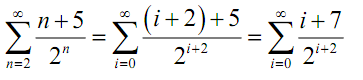
We can now totally rewrite the series in terms of the index i in place of the index n just by plugging in our equation for n in terms of i.
717_Index Shift - Sequences and Series 2.png

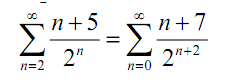
To end the problem out we'll remind that the letter we employed for the index doesn't matter and thus we'll change the final i back into an n to get,
1999_Index Shift - Sequences and Series 3.png

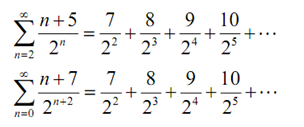
To induce you that these really are similar summation let us write out the first couple of terms for each one of them,
1289_Index Shift - Sequences and Series 4.png

Thus, sure enough the two series do have exactly similar terms.

In fact there is an easier way to do an index shift. The method described above is the technically right way of doing an index shift. Though, notice in the above instance we decreased the initial value of the index by 2 and all the n's in the series terms increased by 2 also. This will all time work in this way.  If we decrease the initial value of the index by a set amount as compared to all the other n's in the series term will increase by similar amount. Similarly, if we increase the initial value of the index by a set amount, after that all the n's in the series term will decrease by similar amount.


Related Discussions:- Index shift - sequences and series

COS Sheets, How do I find percentages with doing COS Sheets

How do I find percentages with doing COS Sheets

Types of infinity, TYPES OF INFINITY : Mostly the students have run across...

TYPES OF INFINITY : Mostly the students have run across infinity at several points in previous time to a calculus class. Though, when they have dealt along with this, this was jus

Method for simultaneous equations of two or more variables, Method In ...

Method In this method we eliminate either x or y, get the value of other variable and then substitute that value in either of the original equations to

Relating addition and subtraction, RELATING ADDITION AND SUBTRACTION :  In...

RELATING ADDITION AND SUBTRACTION :  In the earlier sections we have stressed the fact that to help children understand addition or subtraction, they need to be exposed to various

Pharmacy technician, Tetracycline 500 mg capsules Sig: 1 cap po bid for 14...

Tetracycline 500 mg capsules Sig: 1 cap po bid for 14 days. Refills: 2 What is the dose of this medication:____________________ (0.5 point) How many doses are given per day:______

Diffrential integral , All the integrals below are understood in the sense ...

All the integrals below are understood in the sense of the Lebesgue. (1) Prove the following equality which we used in class without proof. As-sume that f integrable over [3; 3]

What is a scatter diagram, What is a scatter diagram? A scatter diagram...

What is a scatter diagram? A scatter diagram is a graphical representation of data points for a particular sample. Choosing a dissimilar sample or enlarging the original one ca

Write Your Message!

Captcha
Free Assignment Quote

Assured A++ Grade

Get guaranteed satisfaction & time on delivery in every assignment order you paid with us! We ensure premium quality solution document along with free turntin report!

All rights reserved! Copyrights ©2019-2020 ExpertsMind IT Educational Pvt Ltd