Find the normalization transformation, Computer Graphics

Assignment Help:

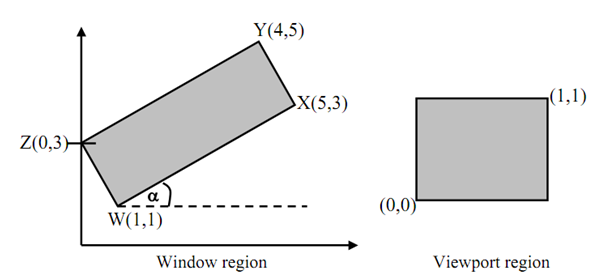
Illustration: Find the normalization transformation N that uses the rectangle W (1, 1), X (5, 3), Y (4, 5) and Z (0, 3) as a window and also the normalized device screen like the viewport.
2190_Find the normalization transformation 1.png

Figure: Example Transformations

Currently, we observe that the window edges are not parallel to the coordinate axes. Consequently we will first rotate the window regarding W hence it is aligned along with the axes.

Now, tan α= (3 -1)/(5-1) = 1/2

⇒ Sin α =    1 /√5;   Cos α = 2/√5

Now, we are rotating the rectangle in clockwise direction. Consequently α is negative which is, - α.

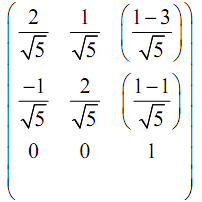
The rotation matrix about W (1, 1):

550_Find the normalization transformation 2.png

[TR.θ]W =

945_Find the normalization transformation 3.png

The x extent of the rotated window is the length of WX:

√(42 + 22) = 2√5

As same, the y extent is length of WZ that is,

√ (12 + 22) =   √5

For scaling the rotated window to the normalized viewport we calculate sx and sy as,

 sx = (viewport x extent)/(window x extent)= 1/2√5

sy = (viewport y  extent)/(window y extent) =   1/√5
925_Find the normalization transformation 4.png

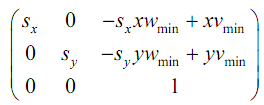
As in expression (1), the common form of transformation matrix showing mapping of a window to a viewport:

[T] =

Within this problem [T] may be termed as N as this is a case of normalization transformation with,

xwmin = 1                        xvmin = 0

ywmin = 1                        yvmin = 0

 sx = 1/2√5      

 sy =  1/√5

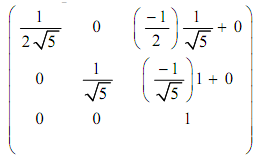
Via substituting the above values in [T] which is N:

N =
1677_Find the normalization transformation 5.png

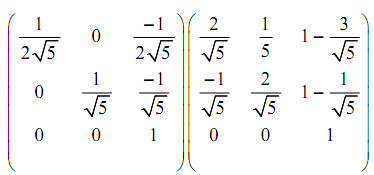
Here, we compose the rotation and transformation N to determine the needed viewing transformation NR.

 NR = N [TR.θ]W =
2096_Find the normalization transformation 6.png


Related Discussions:- Find the normalization transformation

2-d and 3-d transformations, 2-D and 3-D Transformations Previously, w...

2-D and 3-D Transformations Previously, we have presented approaches for the generation of polygonal regions and lines. We identified that once the objects are produced, the v

Compute the height of the resized image, Question) Compute the following: ...

Question) Compute the following:  a) Size of 420 × 300 image at 240 pixels per inch.  b) Resolution (per square inch) of  3 ×  2 inch image that has  768×512 pixels.  c) H

Devi, Explain the 3d transformations

Explain the 3d transformations

Dda and bresenhem line drawing algorithm, when dda algorithm is more effici...

when dda algorithm is more efficient than bresenhem line drawing algorithm

Radiosity - polygon rendering & ray tracing methods, Radiosity - Polygon Re...

Radiosity - Polygon Rendering & Ray Tracing Methods Radiosity simulates the diffuse propagation of light begin at the light sources. Because global illumination is an extremel

Characteristics of vector drawings, Characteristics of vector drawings: Ve...

Characteristics of vector drawings: Vector drawings are generally pretty small files as they include only data about the Bezier curves which form the drawing. The EPS-file format

Explain briefly ancillary operations, Problem: a. Explain briefly six A...

Problem: a. Explain briefly six Ancillary Operations? b. When do ancillary operations take place? c. (i) What is flexography? (ii) Provide examples of finished produ

Orthographic and oblique projection - viewing transformation, Orthographic ...

Orthographic and Oblique Projection - Viewing Transformation Orthographic projection is the easiest form of parallel projection that is commonly utilized for engineering drawi

Languge, what languge do computers speak

what languge do computers speak

Write Your Message!

Captcha
Free Assignment Quote

Assured A++ Grade

Get guaranteed satisfaction & time on delivery in every assignment order you paid with us! We ensure premium quality solution document along with free turntin report!

All rights reserved! Copyrights ©2019-2020 ExpertsMind IT Educational Pvt Ltd