Financial markets-securities and financial intermediaries, Finance Basics

Assignment Help:

Describe the structure of financial systems with financial markets, securities and financial intermediaries.

By a structural point of view a financial system can be considered in terms of the entities which compose the system. A financial system includes financial markets, financial intermediaries and securities.

Financial markets are markets wherein funds are moved by people who have an excess of accessible funds and have lack of investment opportunities to people who have investment opportunities and have lack of funds. It also has directly effects onto personal wealth and the behaviours of consumers and businesses. Thus, they contribute to increase the production and the efficiency into the overall economy. Financial markets as like bond and stock markets are markets wherein securities are traded.
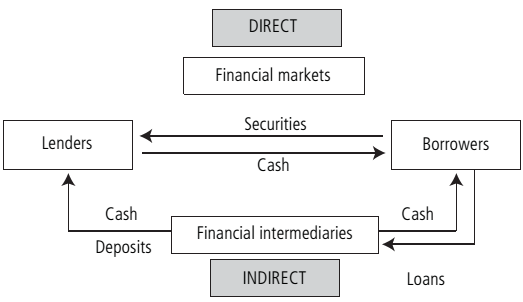
121_Structure of financial systems.png

Structure of financial systems

Securities also termed as financial instruments are financial claims onto the issuer’s future assets or income. They represent financial liabilities for the individual or firm who sells them as borrower or issuer of the financial claim into return for money and financial resources for the buyer as lender or investor into the financial claim. From definition, hence, the sum of financial assets into existence will precisely equal the sum of liabilities.

Governments and corporations increase funds to finance their activities by giving equity instruments (shares, identified in the USA as stocks) and debt instruments (bonds). Bonds are securities which promise to make periodic payments of a sum of money for a given period of time. Stocks are securities which represent a share of ownership into the firm.

Financial intermediaries are economic agents who specialise within the activities of selling and buying (at similar time) financial contracts (loans and deposits) and securities (stocks and bonds). Remember that financial securities are simply marketable, whereas financial contracts cannot be simply sold (marketed). Banks by the largest financial institution into our economy that they accept deposits (loans from individuals or firms to banks) and create loans (sums of money lent by banks to ones or firms): thus, they borrow deposits through people who have saved and into turn make loans to the others. In present years, other financial intermediaries, as like mutual funds, pension funds, investment banks and insurance companies, have been growing at the expense of banks.


Related Discussions:- Financial markets-securities and financial intermediaries

Financial Institution Regulations, Why are financial institutions heavily r...

Why are financial institutions heavily regulated, with specific focus on their ability to increase or reduce the money supply?

Illustrates the roles of money, Illustrates the roles of money? Roles...

Illustrates the roles of money? Roles of Money: a. A medium of exchange An asset which individuals obtain for the intention of trading quite than for their own consump

Need financial econometric assignment help, I need help with financial econ...

I need help with financial econometric questions, i got stuck in finding answers for my homework, Can you provide engineering level financial econometric homework help? I need expe

Long term lenders - measuring business performance, Long Term Lenders - Mea...

Long Term Lenders - Measuring Business Performance Long term lenders These involve finances with loans, mortgages and debenture holders.  These have both short and long

Advantages of development financial institutions, Advantages of Development...

Advantages of Development Financial Institutions Advantages or Functions or can say Case for Development Financial Institutions 1. They grant venture capital 2. They gra

Unbiased Expectations Theory, What is the one-year Treasury security rate o...

What is the one-year Treasury security rate of 1R1? For 1R3=11%, E(2r1)= 4% and E(3r1)=5%

Constant dps plus extra or surplus, Constant DPS plus Extra or Surplus ...

Constant DPS plus Extra or Surplus 1. Beneath this policy a constant DPS is paid every year. Nonetheless extra dividends are paid in years of supernormal earnings. 2. It prov

Roe - return on equity, ROE - Return on Equity The average of the...

ROE - Return on Equity The average of the industry ROE was 21.38% for 2004, 24.99% for 2005, and 23.56% for 2006. The chart showed that after the acquisition of IBM PC di

Finance.., the nominal fee interest rate in your account is 7% your semi-an...

the nominal fee interest rate in your account is 7% your semi-annually rate of interest APY will be?

What are the significant points of fiscal policy, What are the significant ...

What are the significant points of Fiscal Policy? Significant points of Fiscal Policy: a. Meaning of fiscal policy and why this is an significant tool into managing economic

Write Your Message!

Captcha
Free Assignment Quote

Assured A++ Grade

Get guaranteed satisfaction & time on delivery in every assignment order you paid with us! We ensure premium quality solution document along with free turntin report!

All rights reserved! Copyrights ©2019-2020 ExpertsMind IT Educational Pvt Ltd