Explain the photoelectric effect atomic models, Physics

Assignment Help:

Explain the Photoelectric Effect Atomic Models

Heinrich Hertz first observed the photoelectric effect in 1887. He noticed that if a photon with enough energy is absorbed by an atom or molecule in a solid, it can cause the release of an electron moving with kinetic energy equal to the energy left over after overcoming the electron's binding energy. Einstein's interpretation of this effect in 1905 earned him the Nobel Prize in 1921.

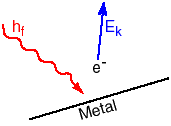
The photoelectric effect has some interesting features. Below a threshold frequency of light, no electrons are emitted, no matter how intense the light is. Different materials have different threshold frequencies. When the frequency of the radiation is above the threshold frequency, even the weakest radiation will make electrons be emitted, and the maximum speed of the electrons is the same as you increase the intensity of the radiation. The number of electrons emitted increases with increasing intensity of the incoming radiation.
 

436_Photoelectric Effect Atomic Models.png

Einstein explained these features by considering radiation to be packaged as a quantum of energy determined by the frequency of the radiation, E = h f. One quantum of energy is a particle called a photon of that frequency radiation. To remove an electron, the photon must supply more energy than the work function of the material, W, the minimum amount of energy to liberate an electron from the material. The electron is emitted with kinetic energy Ek,

  Ek = h f - W

where Ek and W are measured in joules, h = 6.63 x 10⁻³⁴ Js, and f is in hertz. Sometimes a smaller unit of energy, the eV is used. One eV = 1.6 x 10⁻¹⁹ joule. If the frequency of the radiation is increased, the kinetic energy of the electron will be increased.


Related Discussions:- Explain the photoelectric effect atomic models

What is the mass of the board - force, A board that is 1.5 m long is suppor...

A board that is 1.5 m long is supported in two places. If the force exerted by the first support is 25 N and the forced exerted by the second is 62 N. what is the mass of t

Explain mass energy relation, Mass energy relation - The total energy of a...

Mass energy relation - The total energy of a body is the sum of its kinetic energy and rest mass energy. Particle having rest mass zero always move with the velocity of light.

Oscilloscope, How to calibrate an oscilloscope?

How to calibrate an oscilloscope?

Cph theory is able explain the universe future, if CPH has mass, so CPH The...

if CPH has mass, so CPH Theory is able explain the universe future. Universe should collapse. And it is able explain dark matter too. Am I wrong? Answer; you are correct that C

Vectors, i want more clarification on resultant vectors

i want more clarification on resultant vectors

Evaluate the spring constant of the spring, A small ball with a mass of 60....

A small ball with a mass of 60.0 g is loaded into a spring gun, compressing the spring by 12.0 cm. When the trigger is pressed the ball emerges horizontally from the barrel ata hei

Explain electroplating, It is a method of depositing a thin layer of one me...

It is a method of depositing a thin layer of one metal over one more metal by the method of electrolysis. The articles of cheap solids are coated with valuable metals like silver a

How do you use operational amplifier as differentiator, How do you use oper...

How do you use operational amplifier as differentiator and adder/subtractor. Fig. shows differentiator or differentiation amplifier. As its name implies, circuit performs mathe

Write Your Message!

Captcha
Free Assignment Quote

Assured A++ Grade

Get guaranteed satisfaction & time on delivery in every assignment order you paid with us! We ensure premium quality solution document along with free turntin report!

All rights reserved! Copyrights ©2019-2020 ExpertsMind IT Educational Pvt Ltd