Explain independence of vectors quantities, Physics

Assignment Help:

Explain Independence of Vectors Quantities

Perpendicular vector quantities are independent of one another.  This means that the actions of one vector will not affect the actions of another vector. The actions of both vectors determine the resultant. 

Let's consider the typical problem for independence of vector quantities:  the dreaded boat crossing the river problem. 

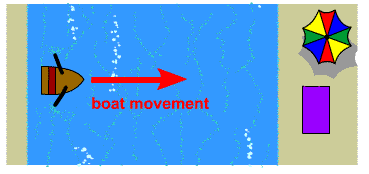
A rowboat is trying to cross the river to get to the picnic on the other side. The river current moves due southward at a rate of 3.0 m/s.  The person in the boat paddles due east at a speed of 4.3 m/s.

Because the boat vector and the current vector are perpendicular to each other, they do not affect each other in any way.  The boat's speed is independent of the current.  Similarly, the current is independent off the boat's speed.

Example 1:

If the river is 265 m wide, how long will it take for the boat to cross the river? 
1580_Explain Independence of Vectors Quantities.png

Here s  where the independence of vector quantities comes in handy.  The speed of the boat across the river is unaffected by the current downstream.  The boat will continue to move due east at a speed of 4.3 m/s no matter what the current is. 

For now, the river current part of the problem was only added to throw you off the track.

To calculate the time it takes to cross the river on the boat, use the factor label method:

265 m * (1 s/ 4.3 m) = 61.6 s

Because the vector quantities are independent, we only needed to use the one in the right direction.


Related Discussions:- Explain independence of vectors quantities

Acceleration due to gravity, Who was the first person to show that all obj...

Who was the first person to show that all objects fall toward Earth with constant _________.

Differential equation for a simple harmonic oscillator, Write down the diff...

Write down the differential equation for a simple harmonic oscillator subjected to a damping force proportional to the velocity (v) of the oscillator and the periodic force of angu

6, A skydiver falls d1 = 495 meters in t1 = 22 s before opening his parachu...

A skydiver falls d1 = 495 meters in t1 = 22 s before opening his parachute. After the chute opens, he falls an additional d2 = 470 meters in t2 = 56.5 s. (a) Write an expression t

Explain one ohm, 1 OHM: If a potential difference of 1 volt is applied ...

1 OHM: If a potential difference of 1 volt is applied across the ends of a conductor and the resulting current flowing by the conductor is 1 ampere, the resistance of the condu

State pressure law, "The pressure of a needed mass of gas at constant volum...

"The pressure of a needed mass of gas at constant volume differs directly as its Kelvin Temperature",

Nicol prism, Q.   Describes the construction of a 'Nicol Prism' and explain...

Q.   Describes the construction of a 'Nicol Prism' and explains its action in converting UPL into PPL. Sol.     Nicol Prism: This is the most simple and elegant polarizer and

Working model, sir, I am in class xii and i have to submit a project:workin...

sir, I am in class xii and i have to submit a project:working model on any topic in physics. so please help me figure this out

The mass of 1 mole of electrons is, The mass of 1 mole of electrons is: ...

The mass of 1 mole of electrons is: (1) 9.1x 10 -28 g (2) 1.008mg (3) 0.55mg (4) 9.1x 10 -27 g Ans:  (3)0.55mg

Explain the formation of the final image of an object, With the help of a r...

With the help of a ray diagram, explain the formation of the final image of an object in a compound microscope. Derive a mathematical expression for its magnifying power.

Write Your Message!

Captcha
Free Assignment Quote

Assured A++ Grade

Get guaranteed satisfaction & time on delivery in every assignment order you paid with us! We ensure premium quality solution document along with free turntin report!

All rights reserved! Copyrights ©2019-2020 ExpertsMind IT Educational Pvt Ltd