Explain how the shuttle sort algorithm works, Data Structure & Algorithms

Assignment Help:

Question 1

Explain how the shuttle sort algorithm works by making use of the following list of integers:11, 4, 2, 8, 5, 33, 7, 3, 1, 6. Show all the steps.

Question 2

Write the outputs for the following Matlab codes
f1=0;
f2=1;
for i = 1 : 10
f3=f2+f1;
disp(f3)
f1=f2;
f2=f3;
end

Question 3

(a) List and describe the operations that can be performed on a stack.

(b) For each operation given in (a), write the implementation using Matlab codes.

Question 4

(a) Construct a tree for the following list of alphabets assuming that a number smaller than the node goes to the left else it goes to the right.

16, 8, 4, 24, 9, 5, 23, 13, 22, 28, 6, 3, 7, 2, 15, 10, 12, 14, 19, 27, 29, 26, 31, 25, 30, 1, 11, 18, 21, 17, 20

(b) Perform inorder, postorder and preorder traversal with the following tree.
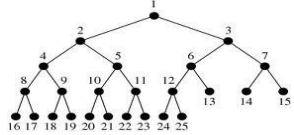
163_Explain how the shuttle sort algorithm works.png

Question 5

Use Prim's algorithm (matrix form) to find a minimum spanning tree and calculate the minimum cost for the graph given below.
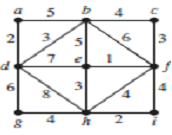
109_Explain how the shuttle sort algorithm works1.png

Question 6

Using Big-O estimate the execution time for the Matlab codes given below. Show clearly all your workings.

1. for i = 1:n-1
2. for j = 1:n-i
3. if a(j) > a(j+1)
4. c=a(j);
5. a(j)=a(j+1);
6. a(j+1)=c;
7. end
8. end
9. end

Question 7

Given the set of items S = {4, 8, 5, 1, 7, 6, 1, 4, 2, 2} and bins of size 10, pack the items into as few bins as possible using Best Fit and Worst Fit. Show all the intermediate steps.


Related Discussions:- Explain how the shuttle sort algorithm works

Comparisons between linear and binary search, Comparative Study of Linear a...

Comparative Study of Linear and Binary Search Binary search is lots quicker than linear search. Some comparisons are following: NUMBER OF ARRAY ELEMENTS EXAMINED array

Frequency counts for all statements, Evaluate the frequency counts for all ...

Evaluate the frequency counts for all statements in the following given program segment. for (i=1; i ≤ n; i ++) for (j = 1; j ≤ i; j++) for (k =1; k ≤ j; k++) y ++;

If, 1. Start 2. Get h 3. If h T=288.15+(h*-0.0065) 4. else if h T=2...

1. Start 2. Get h 3. If h T=288.15+(h*-0.0065) 4. else if h T=216.65 5. else if h T=216.65+(h*0.001) 6. else if h T=228.65+(h*0.0028) 7. else if h T=270.65 8.

Depth first search and breadth first search, Q. Illustrate the result of ru...

Q. Illustrate the result of running BFS and DFS on the directed graph given below using vertex 3 as source.  Show the status of the data structure used at each and every stage.

Division-remainder hashing, According to this, key value is divided by any ...

According to this, key value is divided by any fitting number, generally a prime number, and the division of remainder is utilized as the address for the record. The choice of s

Applications of linear and binary search, The searching method are applicab...

The searching method are applicable to a number of places in current's world, may it be Internet, search engines, text pattern matching, on line enquiry, finding a record from data

Nonrecursive implementation of a recursive algorithm?, What data structure ...

What data structure would you mostly likely see in a nonrecursive execution of a recursive algorithm? Stack

Describe data structure?, Typical programming languages such as Pascal, C o...

Typical programming languages such as Pascal, C or Java give primitive data kinds such as integers, boolean, reals values and strings. They give these to be organised into arrays,

Explain about the containers, Containers Introduction Simple abstr...

Containers Introduction Simple abstract data types are useful for manipulating simple sets of values, such as integers or real numbers however more complex abstract data t

Write Your Message!

Captcha
Free Assignment Quote

Assured A++ Grade

Get guaranteed satisfaction & time on delivery in every assignment order you paid with us! We ensure premium quality solution document along with free turntin report!

All rights reserved! Copyrights ©2019-2020 ExpertsMind IT Educational Pvt Ltd