Explain brifly ribosomes- endoplasmic reticulum , Biology

Assignment Help:

Explain brifly Ribosomes, Endoplasmic Reticulum, Golgi Apparatus ?

Ribosomes, Endoplasmic Reticulum, Golgi Apparatus :  The cytoplasm contains many ribosomes, which are spherical structures about 20 nm in diameter.

Ribosomes synthesize proteins from information provided by DNA and RNA for export from the cell. They are located on the surface of intracellular membranes called endoplasmic reticulum, or ER.
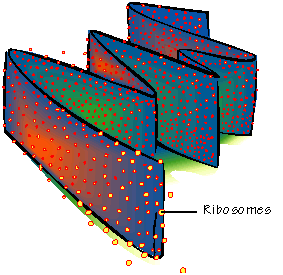
2410_Ribosomes.png

Mitochondria and chloroplasts also contain ribosomes, which are synthesized within those organelles; these ribosomes are somewhat smaller than those found in the cytoplasm. This observation strengthens the theory that mitochondria and chloroplasts were originally prokaryotic cells--bacteria and blue-green algae, respectively. Prokaryotic cells contain thousands of ribosomes; eukaryotic cells may contain millions. The ribosomes of prokaryotes are also smaller than those in the eukaryote cytoplasm.

Sometimes portions of ER and associated ribosomes are found in pancake-shaped assemblies called the Golgi apparatus.

After the protein is synthesized on the ribosomes of rough ER, it moves to the interior of the pancake assembly. It is then processed and packaged by the Golgi apparatus, and transferred to smooth ER, where it is enclosed in a secretory vesicle for transport from the cell.

Some proteins are not exported from the cell, but are used within the cell itself. These are produced by ribosomes that are not associated with the Golgi network.


Related Discussions:- Explain brifly ribosomes- endoplasmic reticulum

Onion cells, What is the process of mitosis in onion root tips in a lab

What is the process of mitosis in onion root tips in a lab

Diversity, who is the farther of bio diversity?

who is the farther of bio diversity?

Define three major steps for study of genetic family tree, What are the thr...

What are the three major steps for a good study of a genetic family tree? Step 1: Determine whether the studied phenotypical form has a dominant or the recessive pattern. Step

What is an example of a hypothesis, What is an example of a hypothesis whic...

What is an example of a hypothesis which may explain why there is not a big representation of the class Reptilia found in polar regions? Beings of the class Reptilia are abunda

What are the sources of nutrients of cornea, What are the Sources of Nutrie...

What are the Sources of Nutrients of Cornea? Sources of Nutrients of Cornea: 1) Oxygen for the endothelium comes from aqueous humour and for epithelium from atmosphere th

Is pollution always caused by humans, Q. Is pollution always caused by huma...

Q. Is pollution always caused by humans? In the most cases pollution is caused by human activity. Other species and some abiotic factors though can also pollute an ecosystem. F

What is tertiary structure of a protein, Q. What is tertiary structure of a...

Q. What is tertiary structure of a protein? What are the major types of tertiary structure? The tertiary protein structure is a spatial conformation additional to the secondary

Can you explain listeriosis, Q. Can you explain Listeriosis? Listeriosi...

Q. Can you explain Listeriosis? Listeriosis is a food borne illness caused by a pathogenic bacterium called Listeria monocytogenes, which is food borne. Listeria monocytogenes

Write Your Message!

Captcha
Free Assignment Quote

Assured A++ Grade

Get guaranteed satisfaction & time on delivery in every assignment order you paid with us! We ensure premium quality solution document along with free turntin report!

All rights reserved! Copyrights ©2019-2020 ExpertsMind IT Educational Pvt Ltd