Explain basic working of ideal operational amplifier, Electrical Engineering

Assignment Help:

Q. Explain basic working of Ideal operational amplifier?

The operational amplifier, known also as op amp, consists of several transistors, diodes, capacitors, and resistors. It is available in integrated-circuit form for less than one U.S. dollar. Being inexpensive, compact, and versatile, operational amplifiers are used in a variety of simple circuits.

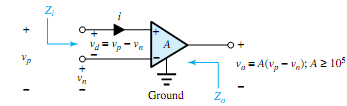
Op-amp circuits, as we will see later, usually contain negative feedback. Op-amp circuits themselves can be regarded as building blocks. These blocks are characterized by their input resistance, output resistance, and open-circuit voltage amplification. The symbol for the op amp is shown in Figure. Two terminals labeled + and - are available for inputs. The voltages of these terminals are labeled with respect to the common terminal,
1801_Explain basic working of Ideal operational amplifier.png

1326_Explain basic working of Ideal operational amplifier1.png

denoted by a ground symbol. The output voltage is related to the difference between the two input voltages as

vo = A(vp - vn)

where A is the open-loop voltage gain. Thus, the op amp is basically a form of differential amplifier, in which the difference vp - vn is amplified. For an output voltage on the order of 12 V, the difference voltage vd is on the order of 0.12 mV, or 120 µV. The input impedance Zi is on the order of 1 M, while the output impedance Zo is on the order of 100  to 1k.


Related Discussions:- Explain basic working of ideal operational amplifier

History - field-effect transistor, History - Field-Effect Transistor: ...

History - Field-Effect Transistor: The principle of field-effect transistors was very first patented by Julius Edgar Lilienfeld in the year 1925 and by Oskar Heil in the year

Define instruction cycle, Define instruction cycle and T-state Instruct...

Define instruction cycle and T-state Instruction cycle is defined, as the time needed completing the execution of an instruction. Machine cycle is defined as the time needed co

Why monitoring and control done, Why Monitoring and control done? Mo...

Why Monitoring and control done? Monitoring and control using microprocessors/computers is often done for the below reasons: - It is safer (faster response to non-standar

Crt and cro, working principle of crtand block diagram of cro

working principle of crtand block diagram of cro

Internal frequency compensation of operational amplifier, Q. Internal Frequ...

Q. Internal Frequency Compensation of operational amplifier? Some op amps, such as the 741, have internal RC networks which are intentionally designed to reduce gain at high fr

Equivalent resistor reductions for the circuit, Q. Determine the voltages V...

Q. Determine the voltages V x using voltage division and equivalent resistor reductions for the circuits shown in Figure.

Illustrate sources and loads, Q. Illustrate Sources and Loads? A source...

Q. Illustrate Sources and Loads? A source-load combination is represented in Figure. A node is a point at which two or more components or devices are connected together. A part

Weins bridge oscillator, please give me the ckt for wein bridge oscillator ...

please give me the ckt for wein bridge oscillator with 5KHz frequency using transister (with exact values of resistor and capacitor).

Modify the jk flip-flop to operate like the t flip-flop, Q. A JK flip-flop ...

Q. A JK flip-flop is shown in Figure (a). (a) Modify it to operate like the D flip-flop of Figure (b). (b) Modify the JK flip-flop to operate like the T flip-flop of Figure (

Write Your Message!

Captcha
Free Assignment Quote

Assured A++ Grade

Get guaranteed satisfaction & time on delivery in every assignment order you paid with us! We ensure premium quality solution document along with free turntin report!

All rights reserved! Copyrights ©2019-2020 ExpertsMind IT Educational Pvt Ltd