Explain a TTL NAND gate and its operation, Computer Engineering

Assignment Help:

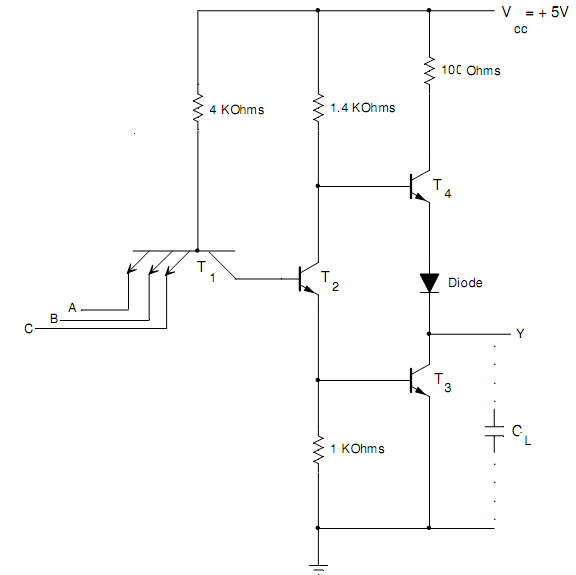
Give the circuit of a TTL NAND gate and explain its operation in brief.

Ans:

Operation of TTL NAND Gate: Fig.(d) Demonstrates a TTL NAND gate with a totem pole output.   The    totem pole output implies that transistor T4 sits atop T3 in order to give low output impedance.  The low output impedance means a short time constant RC therefore the output can change rapidly from one state to the other. T1 is a multiple type emitter transistor. Such transistor can be thought of like a combination of various transistors along with a common collector and base. Multiple emitter transistors along with about 60 emitters have been developed. In this figure, T1 has 3 emitters thus there can be three inputs A, B, C. The transistor T2 functions as a phase splitter since the emitter voltage is out of phase along with the collector voltage. The transistors T3 and T4 by the totem pole output, the capacitance CL shows the stray capacitance and so on. The diode D is added to make sure that T4 is cut off while output is low. The voltage drop of diode D remains the base-emitter junction of T4 reverse biased therefore only T3 conducts while output is low. The operation can be described briefly by three conditions as specified below:

Condition 1: At least one input is low (that is, 0).  Transistor T1 saturates. Thus, the base voltage of T2 is almost zero. T2 is cut off and forces T3 to cut off.  T4 functions as an emitter follower and couples a high voltage to load. Output is high (that is Y=1).

Condition 2: Each input is high. The emitter base junctions of T1 are reverse biased. The collector base junction of T1 is forward biased. Therefore, T1 is in reverse active mode. The collector current of T1 flows in reverse direction. Because this current is flowing in the base of T2, the transistors T2 and T3 saturate and then output Y is low.

Condition 3: The circuit is operating under II while one of the inputs becomes low. The consequent emitter base junction of T1 starts conducting and T1 base voltage drops to a low value.  Thus, T1 is in forward active mode. The high collector current of T1 shifts the stored charge in T2 and T3 and hence, T2 and T3 go to cut-off and T1 saturates and then output Y returns to high.
1437_Logic Diagram of TTL NAND Gate with Totem Pole Output.png

Fig.(d) Logic Diagram of TTL NAND Gate with Totem Pole Output


Related Discussions:- Explain a TTL NAND gate and its operation

What are different edi components and edi services, What are different EDI ...

What are different EDI components and EDI services? Different EDI components and EDI services are illustrated as: Three main components including services in EDI System are

Evaluation functions, Evaluation Functions: Evaluation functions calcu...

Evaluation Functions: Evaluation functions calculate approximately the score which can be prove of guaranteed if a particular world state is reached. Same like in chess, evalu

What is the main problem with segmentation, What is the main problem with s...

What is the main problem with segmentation? Problem with segmentation (i) Is with paging, such mapping needs two memory references per logical address that slows down the

Define edge triggered d flip flop, Define Edge Triggered D flip-flop? D...

Define Edge Triggered D flip-flop? D latch has only two inputs C(control) and D(data). The operation of a D flip-flop is a lot simpler and it has only one input addition to the

C++, find the minimum total number of shelves including the loading process...

find the minimum total number of shelves including the loading process

Explain can we have constant volatile variable, Const and volatile keywords...

Const and volatile keywords should not be used together due to both are opposite in nature. A variable is declared as "const" means its value is not able to be altered but if i

Design a mod-6 synchronous counter, Design a MOD-6 synchronous counter usin...

Design a MOD-6 synchronous counter using J-K Flip-Flops. Ans: Design of Mod-6 Counter:   To design the Mod-6 synchronous counter, contain six counter states (that is, from

Explain serial execution and parallel execution, Serial Execution Exe...

Serial Execution Execution of a program serially, one statement at one instance of time. In the simplest case, that's what takes place on a one processor machine. But even mo

Dynamic memory allocation function, Name the dynamic memory allocation func...

Name the dynamic memory allocation function? Three dynamic memory allocation functions are: a) malloc, b) calloc and c) free.

Explain naming convention in arrays, Explanation Arrays in many programm...

Explanation Arrays in many programming-languages generally show a fixed list of values (e.g. a list of lastnames). Though within SQABasic the size for an array can either be fix

Write Your Message!

Captcha
Free Assignment Quote

Assured A++ Grade

Get guaranteed satisfaction & time on delivery in every assignment order you paid with us! We ensure premium quality solution document along with free turntin report!

All rights reserved! Copyrights ©2019-2020 ExpertsMind IT Educational Pvt Ltd