Example on passing parameters through stack, Computer Engineering

Assignment Help:

Q. Example on Passing Parameters through Stack?

PROGRAM: Version 3

DATA_SEG               SEGMENT

                        BCD DB 25h; Storage for BCD test value

BIN DB?  ; Storage for binary value

DATA_SEG               ENDS

STACK_SEG   SEGMENT      STACK

DW 100 DUP (0); Stack of 100 words

TOP_STACK   LABEL    WORD

STACK_SEG   ENDS

CODE_SEG SEGMENT

ASSUME CS: CODE_SEG, DS: DATA_SEG, SS: STACK_SEG

START:           MOV AX, DATA                  ; Initialise data segment


MOV DS, AX                                    ; using AX register

MOV AX, STACK-SEG.      ; initialise stack segment

MOV SS, AX                         ; using AX register

MOV SP, OFFSET TOP_STACK; initialise stack pointer

MOV AL, BCD                      ; Move BCD value into AL

PUSH AX                               ; and push it onto word stack

CALL BCD_BINARY          ; Do the conversion

POP AX                                  ; Get the binary value

MOV BIN, AL                       ; and save it

NOP                                        ; Continue with program


; PROCEDURE: BCD_BINARY Converts BCD numbers to binary.

; INPUT   : None - BCD value assumed to be on stack before call

; OUTPUT   : None - Binary value on top of stack after return 

; DESTROYS: Nothing

BCD_BINARY PROC NEAR

                                 PUSHF     ; Save flags

                                 PUSH AX; and registers: AX

                                 PUSH BX; BX

                                 PUSH CX; CX

                                 PUSH BP; BP. Why BP?

                                 MOV BP, SP; Make a copy of the

                                                ; stack pointer in BP

                                 MOV   AX, [BP+ 12]; Get BCD number from

                                                ; stack. But why it is on 


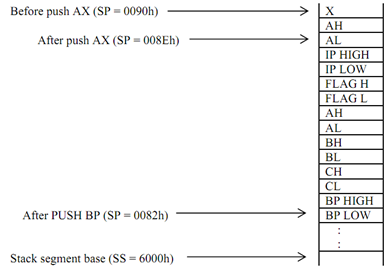
; BP+12 location? Please note 5 PUSH statements + 1 call which is intra-segment (so 

; just IP is stored) so total 6 words are pushed after AX has been pushed and since it is 

; a word stack so the BCD value is stored on 6 × 2 = 12 locations under stack. Hence 

; [BP + 12] (refer to the figure given on next page).

MOV BL, AL; Save copy of BCD in BL

AND BL, 0Fh; mask lower 4 bits

AND AL, F0H; Separate upper 4 bits

MOV CL, 04; Move upper BCD digit to low

ROR   AL, CL; position BCD digit for multiply location

MOV   BH, 0Ah   ; Load 10 in BH

MUL BH; Multiply upper BCD digit in AL by 10

   ; The result is in AL

ADD   AL, BL; Add lower BCD digit to result.

MOV [BP + 12], AX   ; Put binary result on stack

; Restore flags and registers

POP BP

POP CX

POP BX

            POP AX

                                 POPF  

                                 RET  

BCD_BINARY       ENDP

CODE_SEG            ENDS

END   START  


Discussion: 

The parameter is pushed on stack before the procedure call. Procedure call causes the current instruction pointer to be pushed on to stack. In the procedure flags AX, BX, CX and BP registers are also pushed in that order. Hence the stack looks to be:
721_Example on Passing Parameters through Stack.png

The instruction MOV BP, SP transfers contents of the SP to BP register. Now BP is used to access any location in stack by adding appropriate offset to it. For illustration MOV AX, [BP + 12] instruction transfers the word starting at the 12th byte from the top of stack to AX register. It doesn't change the contents of BP register or top of the stack. It copies pushed value of AL and AH at offset 008Eh into the AX register. This instruction isn't equivalent to POP instruction. 

Stacks are useful for writing procedures for multi-user system programs or recursive procedures. It's a decent practice to make a stack diagram as above when using procedure call through stacks. This helps in reducing errors in programming.


Related Discussions:- Example on passing parameters through stack

Why a function should have at least one input, Why a function should have a...

Why a function should have at least one input? There is no strong reason for this in verilog. I think this restriction isn't removed fin SystemVerilog. Some requirements where

Bit serial associative processor (bsap), Bit Serial Associative Processor (...

Bit Serial Associative Processor (BSAP) : When the associative processor accepts bit serial memory organization then it is known as bit serial associative processor. While only one

Static or dynamic - artificial intelligence, Static or Dynamic - artificial...

Static or Dynamic - artificial intelligence An environment is static if it doesn't change while an agent's program is making the decision about how to act. When programming ag

What do you mean by communication traffic, Q. What do you mean by Communica...

Q. What do you mean by Communication Traffic? Communication Traffic offers a pictorial view of communication traffic in interconnection network with respect to time in progress

What are the elements of analysis model, What are the elements of Analysis ...

What are the elements of Analysis model? i. Data Dictionary ii. Entity Relationship Diagram iii. Data Flow Diagram iv. State Transition Diagram v. Control Specifica

Features of hyper-threading, The salient features of hyper threading are: ...

The salient features of hyper threading are: i)  Improved support for multi-threaded code, permitting multiple threads to run concurrently. ii) Response time and improved rea

Constructor, what is meant by private copy constructor

what is meant by private copy constructor

Cache-only memory access model (coma), Cache-Only Memory Access Model (COMA...

Cache-Only Memory Access Model (COMA) As we have discussed previous, shared memory multiprocessor systems may use cache memories with each processor for deducting the execution

What are the different tones used in strowger telephony, What are the diffe...

What are the different tones used in strowger telephony? Explain with the help of waveforms and the timings. Dial Tone: it is used to indicate that the exchange is ready to r

What is the concept of lock, Q. What is the Concept of Lock? Locks are ...

Q. What is the Concept of Lock? Locks are used for protected access of data in a shared variable system.  There are numerous kinds of locks:  1)  Binary Locks: These locks a

Write Your Message!

Captcha
Free Assignment Quote

Assured A++ Grade

Get guaranteed satisfaction & time on delivery in every assignment order you paid with us! We ensure premium quality solution document along with free turntin report!

All rights reserved! Copyrights ©2019-2020 ExpertsMind IT Educational Pvt Ltd