Eliminating data hazards - computer architecture, Computer Engineering

Assignment Help:

Eliminating data hazards:

Forwarding

NOTE: In the following instance, computed values are in bold, whereas Register numbers are not.

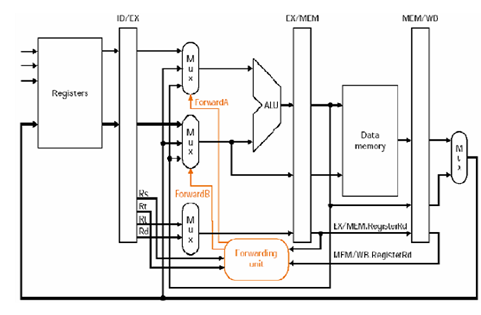
Forwarding involves adding output data into a previous stage of the pipeline. For example, let's assume we desire to write the value 3 to register 1, (which already contains a six), and then add 7 to register 1 and hold the result in register 2, for instance

Instruction 0: Register 1 = 6

Instruction 1: Register 1 = 3

Instruction 2: Register 2 = Register 1 + 7 = 10

Following execution, register 2 would contain the value 10. Though, if Instruction 1 (write 3 to register 1) does not fully exit the pipeline before Instruction 2 begins execution, it means that Register 1 does not contain the value 3 when Instruction 2 performs its addition operation. In such type of event, Instruction 2 adds 7 to the old value of register 1 (6), and so register 2 would contain 13 instead for example Instruction 0: Register 1 = 6

Instruction 1: Register 1 = 3

Instruction 2: Register 2 = Register 1 + 7 = 13

This error takes place because before Instruction 1 has committed/stored Instruction 2 reads1 Register the result of its write operation to Register 1. Thus when Instruction 2 is reading the contents of Register 1, register 1 still contains 6, not 3.

Forwarding (described below) helps right such errors by depending on the fact that the output of Instruction 1 (which is 3) may be utilized by subsequent instructions before the value 3 is committed to/stored in Register 1.

Forwarding is implemented by putting back the output of an instruction into the previous stage(s) of the pipeline as soon as the output of that instruction is available.  Forwarding applied to our instance means that we do not wait to commit/store the output of Instruction 1 in Register 1 (in this instance, the output is 3) before making that output accessible to the subsequent instruction (in this particular case, Instruction 2). The effect is that Instruction 2 uses the right (the more recent) value of Register

1: the commit/store was made instantly and not pipelined.

With forwarding enabled, the ID/EX[clarification needed] stage of the pipeline now has 2 inputs: the value read from the register mention (in this instance, the value 6 from Register 1), and the new value of Register 1 (in this instance, this value is 3) which is sent from the next stage (EX/MEM)[clarification needed]. Additional control logic is utilized to determine which input to use.
813_Eliminating data hazards.png


Related Discussions:- Eliminating data hazards - computer architecture

Which language is a platform free language, Which language  is a platform ...

Which language  is a platform free language Java language

Future scope of the internet, Q. Future scope of the Internet? The futu...

Q. Future scope of the Internet? The future scope of the Internet, along with the World Wide Web (born in 1990), and the commercialization of the Internet are bound to grow exp

Define object oriented and structured development, How object oriented deve...

How object oriented development is dissimilar from structured development object oriented development is dissimilar from structured development of the system. In the structure

How do you create a permanent cookie, How do you create a permanent cookie?...

How do you create a permanent cookie?  By setting the expiry date of the cookie to a later on time (like 10 years later.)

Design a 1-bit full adder, Design a 1-bit full adder: Verify your desig...

Design a 1-bit full adder: Verify your design Use the 1-bit full adder to build a 4-bit adder with Ci=0 Verify: 1 + 4, and 9 + 9 Sram design: Cell: p - 0.5/0.045;

Which work process triggers database changes, Which work process triggers d...

Which work process triggers database changes? Update work process

What are the uses of ramps, What are the uses of Ramps? Ramps: I...

What are the uses of Ramps? Ramps: It is a network planning method which makes the most efficient use of manpower, cash resources and materials among various projects go

Give difference between assembler and interpreter, Give difference between ...

Give difference between assembler and interpreter. Assembler: It is the translator for an assembly language of computer. An assembly language is a low-level programming langu

Equivalence between vhdl and c, Equivalence between VHDL and C? There i...

Equivalence between VHDL and C? There is concept of understanding in C there is structure.Based upon requirement structure provide facility to store collection of various data

#, advantages of dda line algoritm

advantages of dda line algoritm

Write Your Message!

Captcha
Free Assignment Quote

Assured A++ Grade

Get guaranteed satisfaction & time on delivery in every assignment order you paid with us! We ensure premium quality solution document along with free turntin report!

All rights reserved! Copyrights ©2019-2020 ExpertsMind IT Educational Pvt Ltd