Discontinuous integrand- integration techniques, Mathematics

Assignment Help:

Discontinuous Integrand- Integration Techniques

Here now we need to look at the second type of improper integrals that we will be looking at in this section.  These are integrals which have discontinuous integrands.  The procedure here is mainly the same with one subtle variation.  Here are the common cases that we'll look at for these integrals.

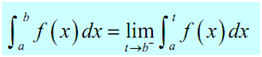
1.   If f (x) is continuous on the interval [a, b] and not continuous at x = b then,
41_Discontinuous Integrand- Integration Techniques 1.png

specified the limit exists and is finite.  Note also that we do need to make use of a left hand limit here as the interval of integration is completely on the left side of the upper limit.

2. Determine If f (x) is continuous on the interval (a, b) and not continuous at x = a then,

1794_Discontinuous Integrand- Integration Techniques 2.png

specified the limit exists and is finite.  In this case we need to make use of a right hand limit here as the interval of integration is completely on the right side of the lower limit.

3.   If f (x) is not continuous at x = c where a < c < b and  ∫ca f(x) dx and ∫bc f(x) dx are both convergent then,

ba f (x) dx

= ∫ ca f(x) dx + ∫ bc f(x) dx

 Since with the infinite interval case this needs BOTH of the integrals to be convergent in order for this integral to as well are convergent.  Determine if either of the two integrals is divergent then so is this integral.

4.   If f (x) is not continuous at x = a and x = b and if  ∫ca f(x) dx and ∫bc f(x) dx are both convergent then

ba f(x) dx = ∫ca f(x) dx + ∫bc f (x) dx

In which c is any number, once Again this needs BOTH of the integrals to be convergent in order for this integral to as well be convergent.


Related Discussions:- Discontinuous integrand- integration techniques

Example of differential equations, y(x) = x -3/2 is a solution to 4x 2 y′...

y(x) = x -3/2 is a solution to 4x 2 y′′ + 12xy′ + 3y = 0 , y (4) = 1/8 , and y'(4) = -3/64 Solution :  As we noticed in previous illustration the function is a solution an

first and third quartiles, From the data given below calculate the value o...

From the data given below calculate the value of first and third quartiles, second and ninth deciles and forty-fifth and fifty-seventh percentiles.

Solution to an initial value problem, S olve the subsequent IVP. dv/dt =...

S olve the subsequent IVP. dv/dt = 9.8 - 0.196v;               v(0) = 48 Solution To determine the solution to an Initial Value Problem we should first determine the gen

Factoring out the greatest common factor, Factoring out the greatest common...

Factoring out the greatest common factor of following polynomials.                    8x 4 - 4 x 3 + 10 x 2  Solution Primary we will notice that we can factor out a

Trig, cot functions

cot functions

Value delivery, What do you mean by value delivery

What do you mean by value delivery

Marketing., what is product life cycle

what is product life cycle

D, similar triangles diagram

similar triangles diagram

integral 0 to pi e^cosx cos (sinx) dx, Let u = sin(x). Then du = cos(x) dx...

Let u = sin(x). Then du = cos(x) dx. So you can now antidifferentiate e^u du. This is e^u + C = e^sin(x) + C.  Then substitute your range 0 to pi. e^sin (pi)-e^sin(0) =0-0 =0

Write Your Message!

Captcha
Free Assignment Quote

Assured A++ Grade

Get guaranteed satisfaction & time on delivery in every assignment order you paid with us! We ensure premium quality solution document along with free turntin report!

All rights reserved! Copyrights ©2019-2020 ExpertsMind IT Educational Pvt Ltd