Determine differential equation from direction field, Mathematics

Assignment Help:

Thus, just why do we care regarding direction fields? Two nice pieces of information are there which can be readily determined from the direction field for a differential equation.

1. Sketch of solutions. As the arrows in the direction fields are actually tangents to the actual solutions to the differential equations we can utilize these as leads to sketch the graphs of solutions to the differential equation.

2. Long Term Behavior. In several cases we are less interested in the actual solutions to the differential equations so we are in how the solutions behave as t raises. Direction fields, if we can find our hands on them, can be utilized to determine information regarding this long term behavior of the solution.

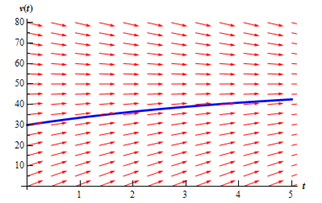
Here back to the direction field for our differential equation. Assume that we need to know what the solution that has the value v (0) = 30 looks like. We can be there our direction field and begin at 30 on the vertical axis. At that point we know that the solution is raising and that as it rises the solution should flatten out since the velocity will be approaching the value of v = 50. So we create drawing a raising solution and while we hit an arrow we just ensure that we stay parallel to such arrow. This provides us the figure as given below.
2454_Determine differential equation from direction field.png

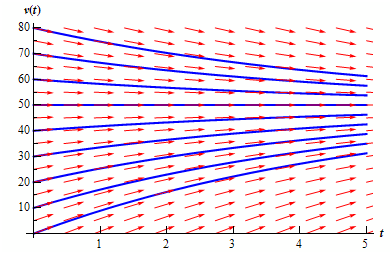
To find a better notion of how all the solutions are behaving, here we put a few more solutions in. Adding several more solutions gives the figure as given below. The set of solutions that we've graphed below is often termed as the family of solution curves or the set of integral curves. The number of solutions which is plotted while plotting the integral curves varies. You must graph sufficient solution curves to demonstrate how solutions in each portions of the direction field are behaving.
289_Determine differential equation from direction field1.png

Here, from either the direction field or the direction field along with the solution curves sketched in we can notice the behavior of the solution as t raises. For our falling object, this looks like all of the solutions will approach v = 50 as t raises.

We will frequently need to know if the behavior of the solution will base on the value of v(0).  In such case the behavior of the solution will not depend upon the value of v (0), although that is possibly more of the exception than the rule so don't specific that.


Related Discussions:- Determine differential equation from direction field

Determine the equation of the line, Example :  Determine the equation of th...

Example :  Determine the equation of the line which passes through the point (8, 2) and is, parallel to the line given by 10 y+ 3x = -2 Solution In both of parts we are goi

Tangents with parametric equations - polar coordinates, Tangents with Param...

Tangents with Parametric Equations In this part we want to find out the tangent lines to the parametric equations given by X= f (t) Y = g (t) To do this let's first r

Decimals, 2.46825141458*1456814314.446825558556

2.46825141458*1456814314.446825558556

Example of probability, Example of Probability: Example: By using...

Example of Probability: Example: By using a die, what is the probability of rolling two 3s in a row? Solution: From the previous example, there is a 1/6 chance of

Tangent, A tangent to a curve at a point is a straight line which tou...

A tangent to a curve at a point is a straight line which touches but does not intersect the curve at that point. A slope of the curve at a point is defined as the

Find the interval of validity for the solution, Solve the subsequent IVP an...

Solve the subsequent IVP and find the interval of validity for the solution xyy' + 4x 2 + y 2 = 0,       y(2) = -7,          x > 0 Solution: Let's first divide on both

Find the shortest paths in the digraph, 1. a) Find the shortest paths from ...

1. a) Find the shortest paths from r to all other nodes in the digraph G=(V,E) shown below using the Bellman-Ford algorithm (as taught in class).  Please show your work, and draw t

Interpretation, Interpretation A high value of r as +0.9 or - 0...

Interpretation A high value of r as +0.9 or - 0.9 only shows a strong association among the two variables but doesn't imply that there is a causal relationship that is

5, what is a variable

what is a variable

Write Your Message!

Captcha
Free Assignment Quote

Assured A++ Grade

Get guaranteed satisfaction & time on delivery in every assignment order you paid with us! We ensure premium quality solution document along with free turntin report!

All rights reserved! Copyrights ©2019-2020 ExpertsMind IT Educational Pvt Ltd