Describe the steps involved in network simplex method, Computer Networking

Assignment Help:

QUESTION 1:

(a) Define what you understand by the following terms in Network Flows:

i) UnDirected Path
ii) Directed Path
iii) Directed Cycle.
iv) Tree

In each of the above, show the differences in terms of nodes and directions.

(b) In Radix Heap Algorithm, the technique of buckets is employed. However this idea is an extension of Dial's Algorithm. Analyse the complexity of Radix Heap Algorithm referring to:

1. Movement of nodes between buckets
2. Node Selection principle

QUESTION 2:

(a) Below is the algorithm of a flow decomposition algorithm.

begin
Initialize
while y ≠ Φ do
begin
              Select(s, y)
              Search(s, y)
              if a cycle C is found then do
              begin
                            let D = Capacity(C, y)
                            Add Flow(D, C) to cycle flows
                            Subtract Flow(D, C) from y.
              end
              if a path P is found then do
              begin
                           let D = Capacity(P, y)
                           Add Flow(D, P) to path flows
                           Subtract Flow(D, P) from y.
               end
end

Describe the complexity of the following:

i) Selecting the initial node,
ii) Finding a cycle or a path,
iii) Update step.

(b) Explain how Lower Bounds on Arc Flows are eliminated. Show your workings by a mathematical representation or otherwise.

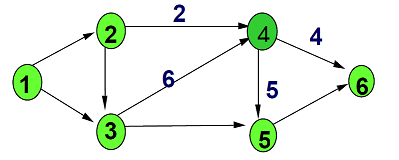
(c) Refer to the diagram below, show how we could always provide a flow of at most 10 on Node 4.
                          1881_11.png

QUESTION 3:

(a) Briefly describe the steps involved in Network Simplex Method.

(b) Referring to Dial's Algorithm and assuming C, to be the Largest arc length, complete the table below.

Variables                                   Cost Value
Number of buckets needed
Time to create buckets.
Time to update d() and
buckets.
Time to find min.
Total running time.

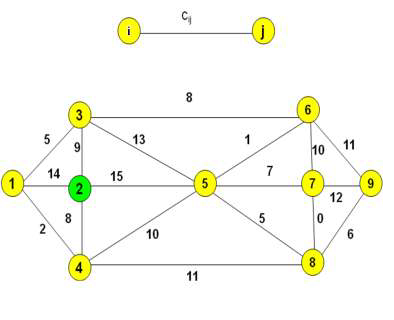
(c) Using Kruskal's algorithm, find the minimum spanning tree of the graph as show in Figure 3.1.
                              1776_11.png

                                                       Figure 3.1

(d) Give mathematical models for the 0-1 knapsack problem and the bounded knapsack problem in Dynamic Programming.


QUESTION 4:

(a) Write down a Generic Label Correcting Algorithm.

(b) Explain how you could detect Negative Cost Cycles in a given set of flows.

(c) Prove that a Negative Cycle Algorithm terminates with an optimal flow.


Related Discussions:- Describe the steps involved in network simplex method

What is fcs, FCS= Frame Check Sequence CRC (Cyclic Redundancy Check) alg...

FCS= Frame Check Sequence CRC (Cyclic Redundancy Check) algorithm runs in switch that known as FCS (Frame Check Sequence)

Calculate the modulation index and find the bandwidth, Consider a signal x(...

Consider a signal x(t) = 10 cos(2πfct + 4 cos 2πfmt). Assume frequency modulation. The message frequency fm = 2:3 kHz. Calculate the modulation index and find the bandwidth when

Two routers running igrp to communicate their routes, What must be true for...

What must be true for two Routers running IGRP to communicate their routes? Ans) Similar autonomous system number

Calculate link utilisation - exchanging packets, a)  Assume that the time r...

a)  Assume that the time required to transmit one packet (i.e. the packet length divided by link data rate) is 10ms and the Round Trip Time (from Source to Destination and back) is

What is a dedicated server, What is a dedicated server? A network serve...

What is a dedicated server? A network server designated to provide one particular service is known as dedicated server. For example if a computer is assigned for database servi

Discuss network designs, This assignment will assess parts of objectives 2-...

This assignment will assess parts of objectives 2-6 from the subject outline: 1 Explain the principles of logical design 2 Discuss the strengths and weaknesses of various net

What is the purpose of configuration files for servers, Question 1: a) ...

Question 1: a) Give three examples of Shells in Linux. b) Differentiate between the Join command and the Paste command in Linux, use an example to support your answer.

Program for two library methods with thread , #include void subdomain(...

#include void subdomain(float x[ ], int istart, int ipoints) { int i; for (i = 0; i x[istart+i] = 123.456; } void sub(float x[ 10000], int npoints) {

Write Your Message!

Captcha
Free Assignment Quote

Assured A++ Grade

Get guaranteed satisfaction & time on delivery in every assignment order you paid with us! We ensure premium quality solution document along with free turntin report!

All rights reserved! Copyrights ©2019-2020 ExpertsMind IT Educational Pvt Ltd