Describe about parallel and perpendicular lines, Mathematics

Assignment Help:

Describe about Parallel and Perpendicular Lines ?

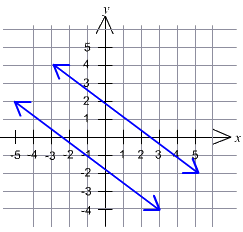
Parallel Lines : Parallel lines are coplanar lines (lines that lie in the same plane) that never intersect.
2217_Parallel and Perpendicular Lines.png


The blue lines are parallel. Notice that these lines have the same slope.
Two lines with the same slope are parallel.
If they had different slope then they would intersect and so they wouldn't be parallel.
If two no vertical lines are parallel, they have the same slope.
What if the lines are vertical?
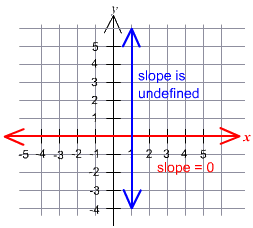
If two vertical lines are parallel, they both have undefined slope.
(See example 2 for more on horizontal and vertical lines.)
Perpendicular Lines
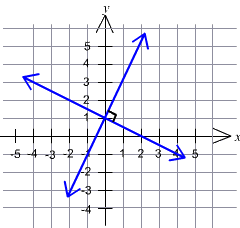
Perpendicular lines intersect at an angle of 90 degrees, in other words they form a right angle.
28_Parallel and Perpendicular Lines 1.png


How do the slopes of these perpendicular lines compare to each other?
1301_Parallel and Perpendicular Lines 2.png


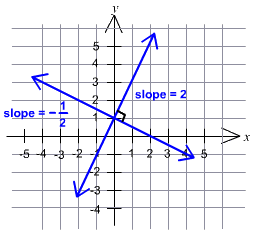
The slopes of the two perpendicular lines are 2 and -1/2. How are these slopes related? -1/2 is the negative reciprocal of 2. (See the basics section for more about negative reciprocals.)
If two lines are perpendicular, their slopes are negative reciprocals.
1752_Parallel and Perpendicular Lines 3.png

If the slopes of two lines are negative reciprocals, then the lines are perpendicular.

Example 1: What is the slope of a line that is
a. parallel to 12x - 3y = 10?
b. perpendicular to 12x - 3y = 10?
Solution: First let's find the slope of the line 12x - 3y = 10.
Put the equation in the form y = mx + b.
12x - 3y = 10
-3y = -12x +10
-3y/-3 = -12x/-3 +10/-3
Y= -4x -10/3
The slope of the line is -4.
a. All lines that are parallel to 12x - 3y = 10 have slope equal to this line. The slope of a line parallel to 12x - 3y = 10 is -4.
b. All lines that are perpendicular to 12x - 3y = 10 have slope equal to the negative reciprocal of -4. The negative reciprocal of -4 is 1/4, so the slope of a line perpendicular to 12x - 3y = 10 is 1/4.

Example 2: What is the slope of a line that is
a. parallel to the x'axis?
b. perpendicular to the x'axis?
Solution: The x'axis is a horizontal line. All horizontal lines have zero slope.
a. A line parallel to the x'axis has slope = 0.
b. A line perpendicular to the x'axis is vertical. All vertical lines have undefined slope.


Related Discussions:- Describe about parallel and perpendicular lines

Climate and vegetation of southeast asia, 1.) How does the monsoon influenc...

1.) How does the monsoon influence the climate and vegetation of Southeast Asia? 2.) What is the main crop in Southeast Asia and the main systems by which it is produce? How and

Analyze the dynamic path - difference equation, One of the well-known class...

One of the well-known class of models that involve a simple difference equation are models of mean reversion. These models typically take the form yt+1 - yt = -a(yt - μ)where 0

Heaviside or step function limit, Heaviside or step function limit : Calcu...

Heaviside or step function limit : Calculates the value of the following limit. Solution This function is frequently called either the Heaviside or step function. We

What is the value of the lesser integer, The sum of three times a greater i...

The sum of three times a greater integer and 5 times a lesser integer is 9. Three less than the greater equivalent the lesser. What is the value of the lesser integer? Let x =

Find the height of the lighthouse, Two  ships  are  sailing  in  the  sea  ...

Two  ships  are  sailing  in  the  sea  on  either  side  of  a  lighthouse;  the  angles  of depression of two ships as observed from the top of the lighthouse are 600  and 450 re

Explain measurement conversions in details, Explain Measurement Conversions...

Explain Measurement Conversions in details? The following tables show measurements of length, distance, and weight converted from one system to the other. Length and Distanc

Multiplication of complex numbers, Multiplication of complex numbers: ...

Multiplication of complex numbers: Example 1: Combine the subsequent complex numbers: (4 + 3i) + (8 - 2i) - (7 + 3i) =  Solution: (4 + 3i) + (8 - 2i) - (7 + 3i

Computation of covariance - ungrouped data, Computation of Covariance ...

Computation of Covariance Ungrouped Data          For a population consisting of paired ungrouped data points {X, Y} where,

Geometry, two sides of an equilateral triangle have lengths 3x-1 and 3x-1. ...

two sides of an equilateral triangle have lengths 3x-1 and 3x-1. Which of 27-x or 2x-4 could be the length of the third side?

Write Your Message!

Captcha
Free Assignment Quote

Assured A++ Grade

Get guaranteed satisfaction & time on delivery in every assignment order you paid with us! We ensure premium quality solution document along with free turntin report!

All rights reserved! Copyrights ©2019-2020 ExpertsMind IT Educational Pvt Ltd