Definition of random variables, Mathematics

Assignment Help:

Q. Definition of Random Variables?

Ans.

Up to this point, we have been looking at probabilities of different events. Basically, random variables assign numbers to elements in a sample space. Random variables are understood best if we first look at a few examples and then define the term afterwards.

If a coin is tossed four times, then we can define a random variable X to be the number of heads tossed, so X can be an integer between 0 and 4.

We can define a random variable to be the number of phone calls a company receives in one day. It can take on integer values between 0 and some very large number.

Random variables can take on values other than integers; for example, let X be a random variable representing a person's height.

Definition

A random variable is a variable that assumes a unique numerical value for each of the outcomes in the sample space of a probability experiment.

We normally denote random variables with capital letters (X, Y, etc.) and denote the actual numbers taken by random variables with small letters (x, y, etc.). So if X is the number of cars in the parking lot, then P(X = x) is the probability that there are x cars in the parking lot.

Random variables can be classified into two types:

Discrete random variables take on integer values.

Continuous random variables take values in some interval of real numbers.

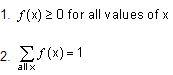
Let f(x) = P(X = x). Then f(x) is called the probability function of X. f(x) assigns probabilities to the values of the random variables.

All probability functions have two properties:
 

1066_Random Variables.png

Notice that these properties ensure that for all f(x) ≤ 1 for all x.


Related Discussions:- Definition of random variables

Example of intersection, Can anybody provide me the solution of the followi...

Can anybody provide me the solution of the following example? You are specified the universal set as T = {1, 2, 3, 4, 5, 6, 7, 8} And the given subjects of the universal s

Caselets, how are indian customers visiting shoppers stop any different fro...

how are indian customers visiting shoppers stop any different from customers of developed western countries

Utilize the chain rule to differentiate, Chain Rule : Assume that we have ...

Chain Rule : Assume that we have two functions f(x) & g(x) and they both are differentiable. 1.   If we define F ( x ) = ( f o g ) ( x ) then the derivative of F(x) is,

A graph with a positive slope, A graph with a positive slope shows that the...

A graph with a positive slope shows that the variables depicted on the axes goes in the similar directions.

Example of vector, Provide the vector for each of the following. (a) The...

Provide the vector for each of the following. (a) The vector from (2, -7, 0) -  (1, - 3, - 5 ) (b) The vector from (1,-3,-5) - (2, - 7, 0) (c) The position vector for ( -

Sum and difference identities, Q. Sum and Difference Identities? Ans. ...

Q. Sum and Difference Identities? Ans. These six sum and difference identities express trigonometric functions of (u ± v) as functions of u and v alone.

prove that 2a=b+c, If the roots of the equation (a-b) x 2 + (b-c) x+ (...

If the roots of the equation (a-b) x 2 + (b-c) x+ (c - a)= 0 are equal. Prove that 2a=b+c. Ans:    (a-b) x 2 + (b-c) x+ (c - a) = 0 T.P 2a = b + c B 2 - 4AC = 0

Write Your Message!

Captcha
Free Assignment Quote

Assured A++ Grade

Get guaranteed satisfaction & time on delivery in every assignment order you paid with us! We ensure premium quality solution document along with free turntin report!

All rights reserved! Copyrights ©2019-2020 ExpertsMind IT Educational Pvt Ltd