Define the type casting?, JAVA Programming

Assignment Help:


Type casting defines treating a variable of one type as though it is another type.

When up casting primitives as given below from left to right, automatic conversion happens. But if you derive from right to left, explicit casting or down casting is needed. Casting in Java is safer and easier than in C or other languages that allow arbitrary casting. Java only lets casts happen when they build sense, such as a cast between a float and an int. However you can't cast between a String and an int.

Byte, short, int, long, float, and double

int i = 5;

long j = i;         //Right. Implicit casting or up casting

byte b1 = i;      //Wrong casting. Compile time error "Type Mismatch".

byte b2 = (byte) i ;       //Right. Explicit casting or Down casting is required.

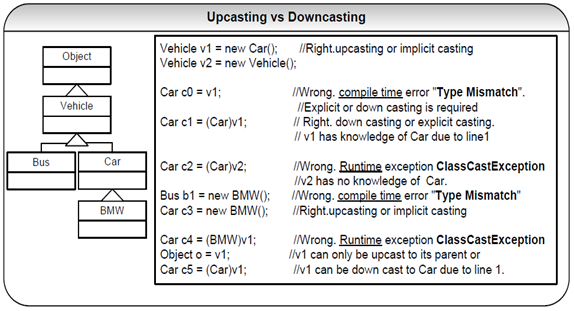
When it needs to object references you may always cast from a subclass to a superclass because a subclass object is also a superclass instance. You may cast an object implicitly to a super class type. If that were not the case polymorphism couldn't be possible.


2281_Untitled.png


You can cast down the hierarchy as well but you have to explicitly write the cast and the object must be a legitimate instance of the class you are casting to. The ClassCastException is given to indicate that code has tried to cast an object to a subclass of which it is not an instance of that class. If you are using J2SE 5.0 then "generics" will remove the need for casting otherwise you may deal with the problem of incorrect casting in two ways:

1.      Use the exception handling process to catch ClassCastException.

2.      Use the instance of statement to protect against incorrect casting.


Related Discussions:- Define the type casting?

2d world of ants and doodlebugs, We have to create a world class that conta...

We have to create a world class that contains a 2d array then create an abstract class called organism that contains move() method the organism should move randomly one step at the

Card, Create a class called DeckOfCards that stores 52 objects of the Card ...

Create a class called DeckOfCards that stores 52 objects of the Card class. Include methods to shuffle the deck, deal a deck, and report the number of cards left in the deck. The s

Create objects of student class by calling default, Create objects of stude...

Create objects of student class by calling default Create objects of student class by calling default, parameterize and copy constructor Call student class different methods on

Illustrate RUP? , Rational Unified Process (RUP) is a normal framework ...

Rational Unified Process (RUP) is a normal framework that may be used to define a development process. The software development life cycle has got 4 parts in the following o

Homework assignment, How do you start the Energy consumption program

How do you start the Energy consumption program

Define about the super() constructer, Super() Constructer: It is used t...

Super() Constructer: It is used to call constructor of parent class. Should be the first statement in the body of constructor. Using this we can access private variables

What is an advice, Advice is the execution of an aspect. It is something li...

Advice is the execution of an aspect. It is something like telling your application of a new behavior. Generally, and advice is inserted into an application at joinpoints

What is spring, Spring is an open source framework created to address the d...

Spring is an open source framework created to address the difficulty of enterprise application development. One of the chief benefits of the Spring framework is its layered archite

Define the difference between stringbuffer and string class, Define the dif...

Define the difference between StringBuffer and String class ?

Write Your Message!

Captcha
Free Assignment Quote

Assured A++ Grade

Get guaranteed satisfaction & time on delivery in every assignment order you paid with us! We ensure premium quality solution document along with free turntin report!

All rights reserved! Copyrights ©2019-2020 ExpertsMind IT Educational Pvt Ltd