Define protection of poly unsaturated fatty acids, Biology

Assignment Help:

Define Protection of poly unsaturated fatty acids (PUFA) from oxidative damage?

The major biological role of vitamin E is to protect PUFAs and other components of cell membranes and low-density lipoprotein (LDL) from oxidation by free radicals. Vitamin E is located primarily within the phospholipid bilayer of cell membranes. It is particularly effective in preventing lipid peroxidation - a series of chemical reactions involving the oxidative deterioration of PUFAs. Elevated levels of lipid peroxidation products are associated with numerous diseases and clinical conditions.

Let us understand the reactions involved in the oxidative deterioration of PLFAs next. The PUFAs, you may recall studying in the Nutritional Biochemistry Course, have methylene (-CHI2-) groups located between two double bonds. This type of functionality makes PUFA particularly sensitive to the flameless oxidation in air that is called autoxidation, because the doubly allelic hydrogen atoms in these methylene carbons are very rapidly abstracted by peroxyl radicals. Free radicals are produced in normal metabolism and by the effects of toxins on tissues.

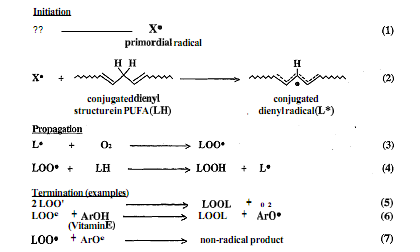
These free radicals (e.g. superoxide produced endogenously by many processes like phagocytosis) can cause the formation of lipid free radicals as shown in the initiation sequence reactions 1 and 2 in Figure. In reaction 2, initiation produces the lipid free radicals and a conjugated dienyl radical (L). The lipid radical L then undergoes the propagation sequence reaction 3 and 4 leading to the formation of lipid hydro peroxides, LOOH.
323_Define Protection of poly unsaturated fatty acids.png


Lipid hydro peroxides produced in autoxidation processes are also formed in enzyme-catalyzed reactions. For example, the enzymes in cyclooxygenase pathway which converts arachidonic acid to several types of hydro peroxides.  These have potent biological properties.

Autoxidation is a chain process. Reactions 3 and 4 continue to alternate until a termination occurs in which two radicals combine to form a new two-electron bond. When vitamin E is absent, from five to twenty five LOOH molecules are formed in reaction 4 for each primordial X radical formed in reaction 1. If vitamin E is present, it traps peroxylradicals to give stable LOOH molecule and a vitamin E radical (Ar O0 in reaction 6). The vitamin E radical is stable enough to seek another LOO* radical as in reaction 7 and complete the termination sequence. In absence of vitamin E, however, each primordial radical produces <1 molecule LOOH. Thus, vitamin E effectively stops the autoxidation chain reaction which converts PUFA to lipid hydro peroxides, LOOH. One molecule of tocopherol can effectively protect 100 or more PUFA molecules from autoxidative damage. Biological membranes generally contain - one percent as many molecules of vitamin E as molecules of PUFA.


Related Discussions:- Define protection of poly unsaturated fatty acids

Psychotropic drugs, Psychotropic Drugs - Act on brain and effect its no...

Psychotropic Drugs - Act on brain and effect its normal functioning slow down and interphere in the functioning of the nervous system. These drugs alter behaviour, consciosn

Determine the applications of biotin, Applications of Biotin Biotin is...

Applications of Biotin Biotin is mainly used in the preparation of injection, and also in the manufacture of vitamin B complex and multi-vitamin preparations. It is used in

Define vitamins and minerals needs in nutrient requirement, Define Vitamins...

Define Vitamins and Minerals needs in Nutrient Requirement and Dietary Management Although the exact requirements are not known, it is generally recommended to give plenty of f

Digestive system - pharynx, PHARYN X - Commom system between digestive...

PHARYN X - Commom system between digestive system and respiratory system. In it gullet and glottis present.Gullet leads to oesophagus. Glottis lead to trachea. Wall of p

Why is water conservation in c3 c4 and cam plants important, Why is water c...

Why is water conservation in c3 c4 and cam plants important? Cam stands for Crassulacean acid metabolism. C3 and C4 conserve less water than Cam plants. Actually, C4 plan

Show major arthropod classes, Q. How are the three major arthropod classes ...

Q. How are the three major arthropod classes characterized according to the presence of antennae? Crustaceans have two pairs of antennae insects have one pair arachnids don't h

Explain about types of insulin, Q. Explain about types of Insulin? Thre...

Q. Explain about types of Insulin? Three types of Insulin is available. The type varies in how quickly it starts working (lowering blood glucose), time of peak activity (when t

Types of cambium, Types of Cambium On the basis of the arrangement of ...

Types of Cambium On the basis of the arrangement of the Fusiform cells as seen in tangential section, cambium is divided into: A) Storied/Stratified Cambium : The groups o

Photosynthesis, Aim: To prove that oxygen is evolved during photosynthesis....

Aim: To prove that oxygen is evolved during photosynthesis. Apparatus: Beaker, funnel, test tube, water, Hydrilla plants. Procedure: Take a few pieces of Hydrilla plant. Keep a

Gumbout chiton, what is the classification of the Gumbout Chiton?

what is the classification of the Gumbout Chiton?

Write Your Message!

Captcha
Free Assignment Quote

Assured A++ Grade

Get guaranteed satisfaction & time on delivery in every assignment order you paid with us! We ensure premium quality solution document along with free turntin report!

All rights reserved! Copyrights ©2019-2020 ExpertsMind IT Educational Pvt Ltd