Define lines parameters, Electrical Engineering

Assignment Help:

Define Lines Parameters

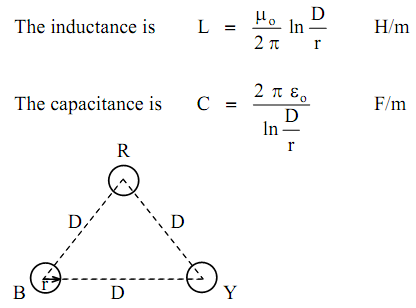
In power system analysis, the parameters of interest when modelling power lines are:  inductance, capacitance, series resistance and leakage resistance. A 3-phase line with equilateral spacing of the conductors is shown in Figure. When performing power system studies on 3-phase systems it is usual to use a single-phase equivalent circuit. Therefore, the equivalent 1-phase or line to neutral (hypothetical neutral conductor) equivalent parameters are of interest. It can be shown that the 1-phase equivalent inductance and capacitance of a 3-phase line (assuming D > > r) are given as:
925_Lines Parameters 1.png

where D  is the distance between the centres of the conductors,

 r  is the radius of the conductors,

  μo = 4 π × 10-7   H/m   is the free space magnetic constant,

  εo = 8.854 × 10⁻¹²  F/m  is the free space electric constant.

It may be of interest to note that  L × C  =  μo × εo

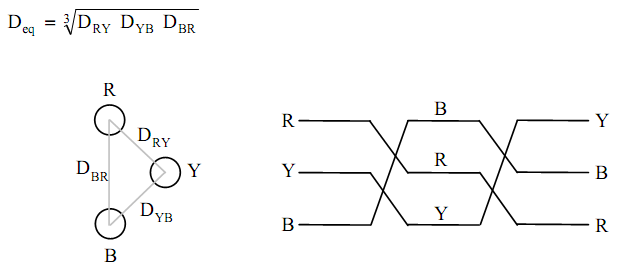
If the conductors are not spaced in the equilateral formation, the flux linkages and hence the inductance of each phase are not the same. It follows that the resultant 3-phase circuit is unbalanced even when the supply voltages and the load currents are balanced. To provide for this problem, the position of the conductors are exchanged at regular intervals along the line, as shown in Figure.

This technique is called 'Transposition'.

In this case, an equivalent spacing between conductors is normally used as:
1103_Lines Parameters.png

The series resistance of the line is the effective a.c. resistance of the conductors which is higher than the d.c. resistance due to skin effect. The leakage resistance represents the combined effect of all various paths from the conductor to earth. It is difficult to assess the value of the leakage resistance due to its dependence on the weather conditions. Normally, its value is very high for most calculation purposes, and the leakage current is negligible.


Related Discussions:- Define lines parameters

Standards and labelling - features of energy conservation, Standards and La...

Standards and Labelling - Features of Energy Conservation Standards and Labelling (S & L) has been recognized as a key activity for improvement in energy efficiency. The S & L

Find the thevenin equivalent, Task 1 Use basic circuit theory to...

Task 1 Use basic circuit theory to convert the "T" circuit below into the equivalent "π". Hint: Remember to disconnect the voltage source and the load. Task 2

Determine the flux densities, In the magnetic circuit shown in Figure (a) t...

In the magnetic circuit shown in Figure (a) the coil of 500 turns carries a current of 4 A. The air-gap lengths are g 1 = g 2 = 0.25 cm and g 3 = 0.4 cm. The cross-sectional are

What layers are covered under end to end layer connectivity, Q. What layers...

Q. What layers are covered under end to end layer connectivity? Layers 4-7 of ISO-OSI reference model communicate with peer entities in end systems. In intermediate systems,th

Explain braking mode of rotating machines, Q. Explain braking mode of rotat...

Q. Explain braking mode of rotating machines? The braking mode has both mechanical and electric energy input. The total input is dissipated as heat. The machine is driven by th

What is capacitance, What is Capacitance -  Capacitance is explained to...

What is Capacitance -  Capacitance is explained to be the amount of charge Q stored in among the two plates for a potential difference or voltage V existing across the plates.

Find the ratio of amplifier gain, The input to the satellite system of Figu...

The input to the satellite system of Figure 1 is a step function θ c (t) = 5u(t) in degrees. As a result, the satellite angle θ(t) varies sinusoidally at a frequency of 10 cycles p

What is direct memory access, What is Direct memory access? Direct memo...

What is Direct memory access? Direct memory access (DMA) is a process wherein an external device takes over the control of system bus by the CPU.DMA is for high-speed data tran

Determine the forced component of the voltage, Q. Consider an RL series cir...

Q. Consider an RL series circuit excited by (a) v(t) = 20e -2t V, and (b) v(t) = 20 V. Determine the forced component of the voltage across the inductor for R = 2  and L = 2H.

Write Your Message!

Captcha
Free Assignment Quote

Assured A++ Grade

Get guaranteed satisfaction & time on delivery in every assignment order you paid with us! We ensure premium quality solution document along with free turntin report!

All rights reserved! Copyrights ©2019-2020 ExpertsMind IT Educational Pvt Ltd