Create algorithm for similarities between documents, Data Structure & Algorithms

Assignment Help:

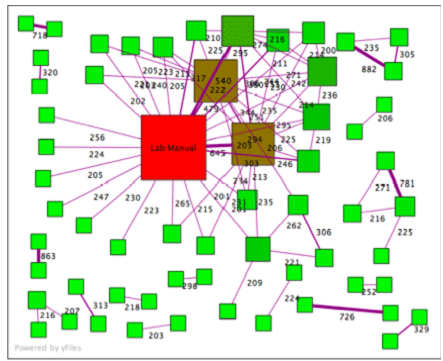
Here is a diagram showing similarities between documents; this is an actual set of physics lab assignments from a large university.
2442_similarities between documents.png

Each node (square) in the graph is a document. Each edge (line) connects two documents based on the number of 6-word phrases they have in common. To reduce noise, only documents sharing more than 200 6-word phrases are shown. The red square is the lab manual, and the brown squares are two sample lab reports that were distributed in class. (Apparently many students 'borrowed' heavily from these documents.) But if we look carefully, we notice that several papers share a large number of phrases in common with each other and with no other documents. For example, a pair at the top left share 718, a pair at the top right show 882, and a pair on the lower left share 863 6-word phrases in common. It's likely that those people turned in essentially the same lab report or copied from each other. Your program will read through a directory full of files and identify pairs of files that share more than 200 6-word phrases, as a means of detecting copied work.

It's important to understand what we mean by "6-word phrases." It's not just looking at 6 words, then the next 6, etc.; after all, even plagiarists are smarter than that. A 6-word phrase is a word and the following 5 words, for each word with at least 5 words after it. So, for example, the text:

Now is the time for all good men to come to the aid of their country.

Contains the 6-word phrases:

Now is the time for all

is the time for all good

the time for all good men

time for all good men to

...and so on.

Thus, a single extended passage can generate many duplicates. On the other hand, a sentence that happens to begin with "Now is the time..." will be less likely to generate more than a few 'hits' as duplicate phrases. For our purposes, upper- or lower-case doesn't matter, nor does punctuation.


Related Discussions:- Create algorithm for similarities between documents

Algorithm to merge the lists together, Q. Let X = (X1, X2, X3,....Xn) and Y...

Q. Let X = (X1, X2, X3,....Xn) and Y= (Y1, Y2, Y3,....Xm) be the two linked lists respectively. Write down an algorithm to merge the lists together to get the linked list Z such th

B-tree of degree 3, Q. Explain the result of inserting the keys given. ...

Q. Explain the result of inserting the keys given. F, S, Q, K, C, L, H, T, V, W, M, R, N, P, A, B, X, Y, D, Z, E  in an order to an empty B-tree of degree-3.

Process of post-order traversal, Post-order Traversal This can be done ...

Post-order Traversal This can be done both iteratively and recursively. The iterative solution would need a change of the in-order traversal algorithm.

Merging, Merging two sequence using CREW merge

Merging two sequence using CREW merge

Terminology used for files structures, Given are the definitions of some im...

Given are the definitions of some important terms: 1) Field: This is an elementary data item characterized by its size, length and type. For instance, Name

Linked lists - implementation, The Linked list is a chain of structures whe...

The Linked list is a chain of structures wherein each structure contains data in addition to pointer, which stores the address (link) of the next logical structure in the list.

Program, insertion and deletion in a tree

insertion and deletion in a tree

Bubble sort, Q. The reason bubble sort algorithm is inefficient is that it ...

Q. The reason bubble sort algorithm is inefficient is that it continues execution even after an array is sorted by performing unnecessary comparisons. Therefore, the number of comp

Various passes of bubble sort, Q. Show the various passes of bubble sort on...

Q. Show the various passes of bubble sort on the unsorted given list 11, 15, 2, 13, 6           Ans: The given data is as follows:- Pass 1:-     11   15   2     13

Pseudocode algorithm to print the numbers from 1 to 10, 1. Write a pseudoco...

1. Write a pseudocode algorithm to print the numbers from 1 to 10, and then from 10 to 1, using exactly one loop. 2. The function contains() takes a food as an argument and tell

Write Your Message!

Captcha
Free Assignment Quote

Assured A++ Grade

Get guaranteed satisfaction & time on delivery in every assignment order you paid with us! We ensure premium quality solution document along with free turntin report!

All rights reserved! Copyrights ©2019-2020 ExpertsMind IT Educational Pvt Ltd