Compute the cross-sectional area, Physics

Assignment Help:

Assigned homework

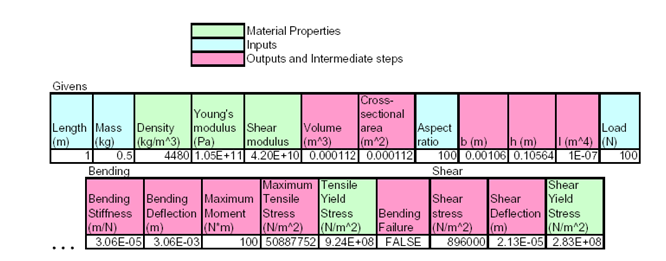
a. The objective of this problem is to get a sense of the tradeoff between cross-section and stiffness for beam structural member. Consider a beam that is 1 meter long and is allowed no more than 0.5 kg mass. For this exercise we will use Aluminum 2024-T3, with the following properties.
2077_Compute the Cross-Sectional Area.png

Density: 2780 kg/m^3

Young's Modulus: 73.1 GPa

Shear Modulus: 28 GPa

Tensile Yield Stress: 345 MPa

Shear Yield Stress: 283 MPa

Using Excel, and the relationships described in lecture for beams, create a worksheet which allows you to answer the following questions. The worksheet will likely have the following columns.  

1. Given the density, length, and total mass of the aluminum beam, what is the volume of aluminum available, and what is the cross-sectional area?

2. The allowable area can be distributed in any shape we want. For this exercise we will consider only rectangular cross-sections. Although area is fixed by the beam mass, we can vary the aspect ratio to get different base and height dimensions. What are the equations for h and b in terms of A and aspect ratio r?

 3. For the cases of aspect ratio 100, 10, 1, 0.1, 0.01, what are the moments of inertia of the resulting cross-sections, the bending deflection, and the maximum stress due to bending?

4. For which aspect ratios does the bending stress exceed yield stress of the beam?

5. How much greater is the bending deflection than the shear deflection for the aspect ratio = 1 case?

b. Discuss / compare the factors needed to consider to accurately compute the wheel load of various transportation devices, starting with a unicycle, then a segway, tricycle, grocery shopping cart, an automobile and then a tank tread. Describe how it becomes increasingly difficult to accurately determine the wheel load and the factors needed to be considered to overcome those difficulties.


Related Discussions:- Compute the cross-sectional area

Ampere, Ampere; A (after A.M. Ampere, 1775-1836) The basic SI unit of e...

Ampere; A (after A.M. Ampere, 1775-1836) The basic SI unit of electric current, described as the current that, while going through two infinitely-long parallel conductors of ne

Explain the construction of gamma camera, Question 1 Discuss the physical ...

Question 1 Discuss the physical characteristics of an X-ray beam. Write a note on factors influencing the quality and intensity of the X-ray beam Question 2 Explain the const

Vectors, if A=[30.1, 21.4 degrees] and B= [25, 40 degrees] what is the magn...

if A=[30.1, 21.4 degrees] and B= [25, 40 degrees] what is the magnitude of the sum of these two vectors

Explain inertial frame of reference, INERTIAL FRAME OF REFERENCE:  "A f...

INERTIAL FRAME OF REFERENCE:  "A frame of reference which is not being accelerated and it might be at rest or moving with uniform velocity is known as inertial frame of referen

Show the definition for power, Question: What all are able to the power...

Question: What all are able to the power P possibly represent in the expression P = IV where I is current and V is voltage? Answer: The small definition for power is th

polyatomic gas, ratio of specific heats of polyatomic ga

ratio of specific heats of polyatomic gas

Interferometer, working and construction of interferometer

working and construction of interferometer

Nucleus has negative mass defect, Tell me Is it possible that a nucleus has...

Tell me Is it possible that a nucleus has negative mass defect    If the nucleus has a mass defect it is likely that the strong force and the weak force have sustained a main

Write Your Message!

Captcha
Free Assignment Quote

Assured A++ Grade

Get guaranteed satisfaction & time on delivery in every assignment order you paid with us! We ensure premium quality solution document along with free turntin report!

All rights reserved! Copyrights ©2019-2020 ExpertsMind IT Educational Pvt Ltd