Comparison between centralized and distributed spc, Computer Engineering

Assignment Help:

Explain the principles of operation of centralized SPC and distributed SPC and compare their performance.

All the control equipment is replaced with a single processor that must be rather powerful, in centralized control. This must be able of processing 10 to 100 calls per second, depending upon the load on the system, and concurrently performing various ancillary tasks. A typical an ESS control configuration by using centralized SPC is demonstrated in figure. A centralized SPC configuration may utilize more than one processor for redundancy reasons; two approaches are there to organizing stored program control:

Centralized: In this type control, all the control equipment is replaced with a single processor that must be fairly powerful.

Distributed: In such controlling, the control functions are shared through many processors within the exchange itself.

Dual processor architecture may be configured in centralized SPC to operate in one of three modes which are given below:

Standby mode: In this, one processor is active and another is on standby, both software and hardware wise. This standby processor brought online while active processor fails. Significant requirement of this configuration is the capability of the standby processor to reconstitute the state of the exchange system, while this takes over the control.

Synchronous duplex mode: In this mode, hardware coupling is given between the two processors that execute similar set of instructions and compare the results continuously. When a mismatch arises, the faculty processor is specified and taken out of service instantly. If the system is operating generally, the two processors have similar data in their memories at all the time and receive all information from the exchange environment.

Load sharing mode: In this operation, an incoming call is allocated randomly or into a predetermined order to one of the processors that after this handles the call right by completion. Therefore both the processors are active concurrently and share the resources and the load dynamically.
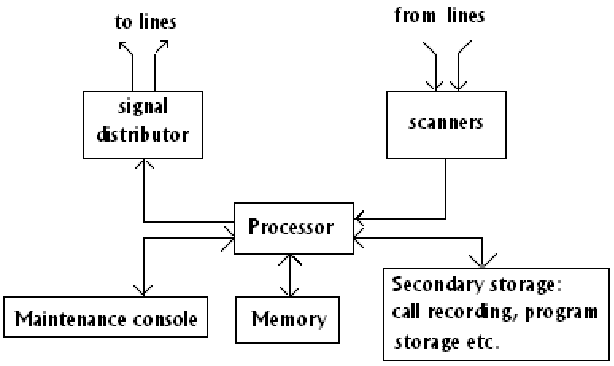
1191_Typically Centralized SPC Organization.png

FIG - Typically Centralized SPC Organization.


Related Discussions:- Comparison between centralized and distributed spc

How can you have an accession number, Accession number (bioinformatics), a ...

Accession number (bioinformatics), a unique identifier given to a biological polymer sequence (DNA, protein) when it is given to a sequence database.

Describe _blank, Q. Describe _blank, _self, _parent and _top tags? Thes...

Q. Describe _blank, _self, _parent and _top tags? These all are attributes of tag. The below example describes each of these attributes. <

Perform multiplication with showing content of accumulator, Perform multipl...

Perform multiplication with showing the contents of accumulator, B register and Y register during each step. (Accumulator, B, Y are 4-bit registers) B=06 Y=02

Explain about data segment, DATA SEGMENT  NUM1            DB      15h;...

DATA SEGMENT  NUM1            DB      15h;     First number   NUM2            DB      20h;     Second number  RESULT DB?  ; Put sum here  CARRY DB? ; Put any carry he

Data structure, How does dynamic memory allocation help in managing data

How does dynamic memory allocation help in managing data

Concurrently read exclusively write, Q. Concurrently read exclusively write...

Q. Concurrently read exclusively write? It's one of the models based on PRAM. In this model, processors access the memory location simultaneously for reading whereas exclusivel

Permanently resident pages - main memory, Permanently resident pages: ...

Permanently resident pages: Every virtual memory systems have memory areas that are "pinned down", for example cannot be swapped out to secondary storage, for instance:

K map explanation, K map explanation for mod 5 up synchronous counter ?

K map explanation for mod 5 up synchronous counter ?

What is a heap, What is a heap? The heap is an area of memory that is ...

What is a heap? The heap is an area of memory that is dynamically allocated. As a stack, this may grow and shrink throughout runtime. Not like a stack, a heap is not LIFO show

Write Your Message!

Captcha
Free Assignment Quote

Assured A++ Grade

Get guaranteed satisfaction & time on delivery in every assignment order you paid with us! We ensure premium quality solution document along with free turntin report!

All rights reserved! Copyrights ©2019-2020 ExpertsMind IT Educational Pvt Ltd